
Gajendra Thakur
A PARALLEL HISTORY OF MITHILA & MAITHILI LITERATURE- PART 71
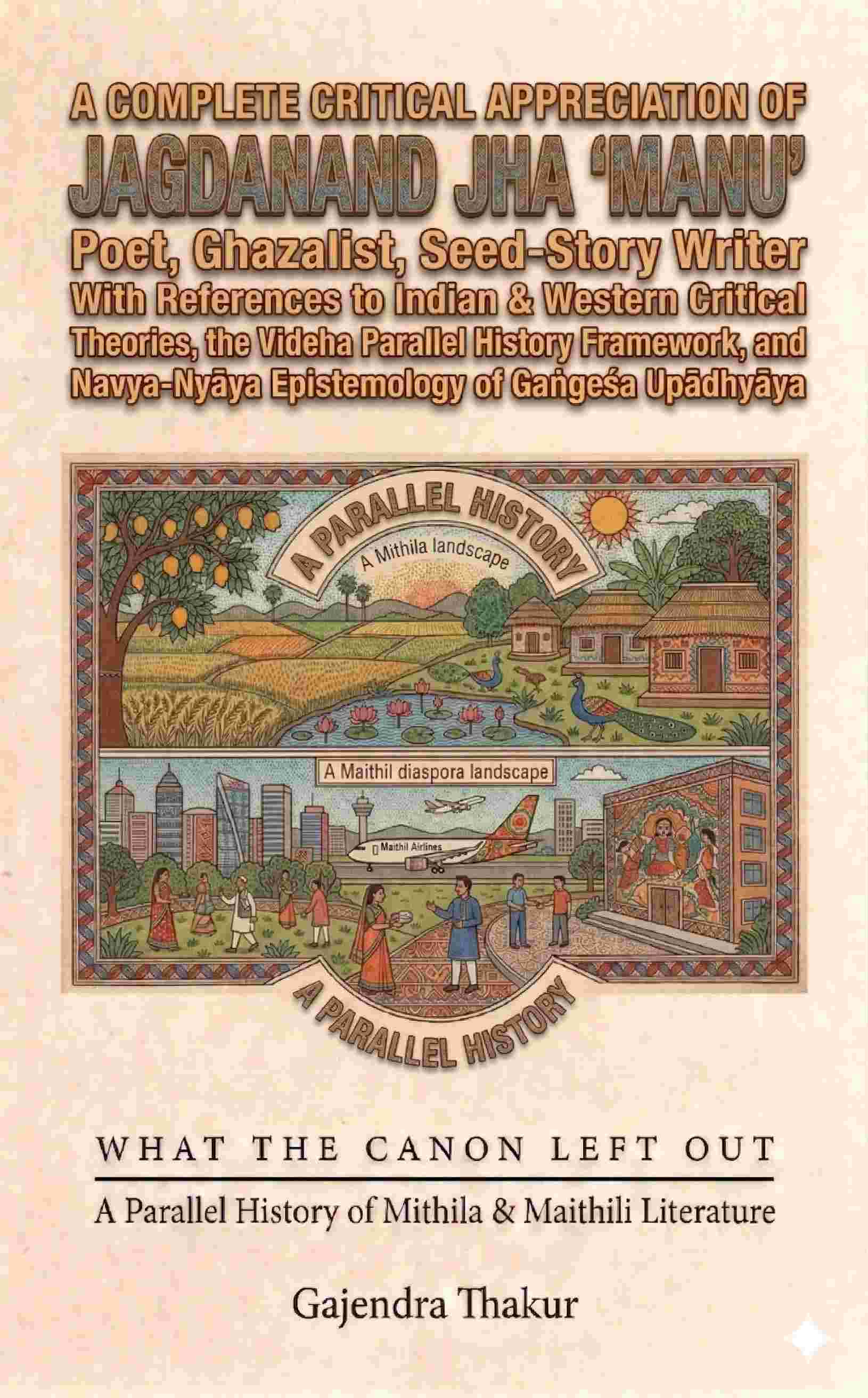
A COMPLETE CRITICAL APPRECIATION OF JAGDANAND JHA 'MANU' Poet Ghazalist Seed-Story Writer With References to Indian & Western Critical Theories, the Videha Parallel History Framework, and Navya-Nyāya Epistemology of Gaṅgeśa Upādhyāya
A COMPLETE CRITICAL APPRECIATION OF
JAGDANAND JHA 'MANU'
Poet · Ghazalist · Seed-Story Writer
With References to Indian & Western Critical Theories,
the Videha Parallel History Framework,
and Navya-Nyāya Epistemology of Gaṅgeśa Upādhyāya
Abstract
Jagdanand Jha 'Manu' is one of the most versatile and prolific voices in the contemporary Maithili parallel literary tradition. A poet, ghazalist, and seed-story (bīhani kathā) writer, he has published multiple collections across three genres: the poetry and song anthology Vyathā (2025, Pallavi Prakashan; ISBN 978-93-48865-53-3), the ghazal collection Naḍhiyā Bhukaiye Hamar Ghaṛārīpar (1st ed. 2022, 2nd ed. 2023; ISBN 978-93-93135-18-6), the seed-story anthology Tohār Katek Raṅg (2022; ISBN 978-93-93135-29-2), and children's stories in the Videha Shishu Utsav series ('Chonhā', Shishu Utsav 51–100). His literary formation began through the Videha digital platform (2010) and was shaped by the Anchinhar Ākhara movement, which restored formal prosodic rigour to the Maithili ghazal after a 'dark interlude' of grammatically incorrect practice. This critical appreciation applies Indian classical theories (Rasa, Dhvani, Vakrokti, Alamkāra), Western frameworks (Formalism, Marxism, New Criticism, Postcolonialism, Gender Theory, Ecocriticism), the Videha Parallel History Framework, and the epistemological techniques of Navya-Nyāya logician Gaṅgeśa Upādhyāya to assess Manu's literary corpus. The study argues that Manu exemplifies the digital-democratic strand of Maithili parallel literature: a writer who came to letters as a migrant labourer from rural Mithila, without institutional literary education, using the digital-first infrastructure of the Videha movement to develop a technically rigorous yet emotionally immediate literary voice rooted in the pain of displacement, the love of mother-soil, and the struggle for dignity.
I. Biographical and Contextual Introduction
1.1 Life, Origins, and the Migrant Condition
Jagdanand Jha 'Manu' was born into a Maithili-speaking family of rural Bihar. His pen name 'Manu' — chosen in homage to the primordial lawgiver and simultaneously a name of domestic tenderness in Maithili — signals a creative self-construction: the writer fashioning an identity between the universal and the intimate. His email address (jagdanandjha@gmail.com) and mobile/WhatsApp contact (+91 9212-46-1006) — published in his books — reflect the Videha movement's ethic of accessibility: the author is not a remote institutional figure but a communicating presence.
The biographical fact that overshadows all of Manu's writing is the experience of migration. He is, by his own repeated testimony, a pardeshī — an outsider in the urban centres of Delhi, Mumbai — who has left his Maithili village for economic survival, yet remains spiritually and aesthetically bound to the 'māṭi-pānī' (soil and water) of Mithila. This condition — the internal migrant who earns his bread in a metropolis while his heart remains tethered to Madhubani fields, to the fragrance of mahuā blossoms, to his grandmother's house, to the Chhath festival by the pond — is the lived experience from which all his literary production flows.
In the prefatory note to Naḍhiyā Bhukaiye Hamar Ghaṛārīpar, Manu writes with disarming honesty: 'I have no great knowledge, no literary education in any formal sense. My Maithili was weak when I began; it remains imperfect. But what I have is the love of this soil.' He credits his literary birth to Gajendra Thakur, who connected him to the Videha Facebook group around 2010, and his formal ghazal training to mentor Ashish Anchinhar, who guided him from 2011 onwards through the Anchinhar Ākhara movement. The dedication of Vyathā to his late 'Dādā Bābā' Dr. Kamalakant Jha — described as 'the source of my literary inspiration' — reveals a family inheritance of scholarly culture even within economic constraint.
1.2 The Videha and Anchinhar Ākhara Formations
Manu's literary career is inseparable from two institutional formations: the Videha eJournal (videha.co.in, ISSN 2229-547X) — the first Maithili fortnightly e-journal, founded by Gajendra Thakur — and the Anchinhar Ākhara movement, launched April 11, 2008, which restored formal prosodic standards to the Maithili ghazal through the Ghajalsastram (the first comprehensive Maithili-language theoretical account of ghazal prosody).
The Videha Parallel History Framework (Parts 1–35+, videha.co.in/gajenthakur.htm) positions the Anchinhar Ākhara movement as a correction of what it calls the 'dark interlude' of Maithili ghazal-writing — a period in which grammatically incorrect ghazals (violating bahra and qāfiyā norms) came to dominate, and technically correct practitioners like Vijaynath Jha and Yoganand Heera were erased from literary history. Ashish Anchinhar published Maithili Ghazalak Vyākaraṇa o Itihāsa (Grammar and History of Maithili Ghazal), providing the systematic theoretical framework through which Manu and 350–400 other previously marginalised writers entered the literary mainstream within a single decade.
The digital-first strategy of the Anchinhar movement — blog, Wikipedia, online mushaira — is directly implicated in Manu's trajectory: he is a product of digital democratisation. He would not have become a published literary figure without the blog, the Facebook group, the online mushaira circuit. This makes him emblematic of what the Parallel History calls the 'Videha Era: The Digital Era 2000–Present' — the transformation of Maithili literature through internet access, which bypassed the caste-based institutional gatekeeping of the Sahitya Akademi apparatus.
1.3 Publisher and Institutional Location
Manu publishes exclusively through Pallavi Prakashan, Nirmali, Supaul — the same press that publishes Nand Vilas Roy and other writers of the democratic-parallel tradition. Dr. Umesh Mandal, who manages Pallavi Prakashan, also handled the typography and page-setting of all Manu's books. The Nirmali connection is not accidental: Nirmali (Supaul district) is a small Bihar town that has become a publishing hub for the Maithili parallel tradition precisely because it lies outside the Delhi-Darbhanga establishment axis.
II. The Corpus: Works, Forms, and Publication History
2.1 Vyathā: Poetry and Song Anthology (2025)
Vyathā (व्यथा — 'Anguish' or 'Pain') is Manu's most substantial single-volume literary achievement to date. Published by Pallavi Prakashan in 2025 (ISBN 978-93-48865-53-3; price ₹290), it contains 34 poems (kavitā) and 16 songs (gīt). Cover art is by Smt. Aparna Sarkar, Noida. The preface by Dr. Ram Ashish Singh (former principal, H.P.S. College, Nirmali; Veer Kunwar Singh University, Madhepura) provides a scholarly introduction situating Manu's poetics.
The table of contents reveals the collection's thematic architecture in two parts. Part 1 (kavitā, poems 1–34) opens with 14 poems on Mithila — its glories, its decline, the grief of separation — and then moves through poems on women ('Ham Nārī Nahi' — 'I am Not a Woman' [the ironic inversion], 'Konā Madar Day Happy'), consciousness ('Monak Vyathā'), maternity ('Māe'), the poet's vocation ('Hami Kavi Nahi Chhi'), economic conditions ('Pāi' — 'Money'), mortality ('Ek Din Hami Marab'), and political satire ('Dūlhā Ājuken' — 'Today's Groom', 'Ghaṭakak Jawāb' — 'The Matchmaker's Answer', 'Rojgār Banāo Kavitā' — 'Make Employment, Poetry'). Part 2 contains 16 songs (gīt) including devotional compositions for the Chhath festival ('Bhola Bābāk Gīt', 'Māiyāk Gīt').
The preface frames Manu's poetics through Wordsworth's definition of poetry as 'the spontaneous overflow of powerful feelings' — a significant choice that positions him within a Romantic-realist synthesis. Dr. Singh's phrase 'yathārthavādī kavitā' (realist poetry) for Manu's dominant mode is accurate, though the collection also contains strongly imaginative-devotional passages in the gīt section.
2.2 Naḍhiyā Bhukaiye Hamar Ghaṛārīpar: Maithili Ghazal Collection
Naḍhiyā Bhukaiye Hamar Ghaṛārīpar ('The Dog Barks at My Homestead') is Manu's landmark contribution to the Maithili ghazal tradition. First published 2022, second edition 2023 (ISBN 978-93-93135-18-6; price ₹200), it was edited in e-book form as early as 2014 before its print appearance. The collection contains 101 ghazals organised by prosodic form (bahra): ghazals 1–36 in Saral Vārṇik Bahra (simple syllabic metre), ghazals 37–47 in equal syllabic verse, ghazals 48–50 in Bahra-e-Mutaqārib, 51–56 in Bahra-e-Ramal, 57–58 in Bahra-e-Rajaz, 59–60 in Bahra-e-Hazaj, 61–62 in Bahra-e-Mushākil, 63 in Bahra-e-Asam, 64–65 in Bahra-e-Khafūk, 66 in Bahra-e-Jadīd, 67–79 in Bahra-e-Kalīb, 70–71 in Bahra-e-Kabīr, 72 in Bahra-e-Hamīd, 73 in Bahra-e-Mujassam or Mujās, 74–75 Hazal, 76–88 Bāl Ghazal (children's ghazals), and 89–101 Bhakti Ghazal (devotional ghazals). This organisation by bahra is itself a pedagogical and political statement: it demonstrates mastery of the prosodic range and teaches the forms to readers.
The dedication — to all those who 'keep the rebellion of their homeland soil alive in their hearts despite being far from it' — encapsulates the collection's dominant affect. The title poem (Ghazal 4) uses the village dog's barking at an empty homestead as the central image of the abandoned Maithili home: the dog, guardian of the hearth, now barks at a vacant house whose owner has left for the city.
2.3 Tohār Katek Raṅg: Seed Stories (Bīhani Kathā) Collection
Tohār Katek Raṅg ('How Many Colours Are Yours?') is Manu's collection of Maithili bīhani kathā (seed stories), published in 2022 (ISBN 978-93-93135-29-2; price ₹200). As a bīhani kathā collection, it situates Manu within the genre that the Videha Parallel History (Part 32) identifies as 'a micronarrative form unique to Maithili literature': the seed story is 'not simply a compressed short story but a genetically distinct form' characterised by 'seed logic — an ending that opens rather than closes meaning.' The title — 'How Many Colours Are Yours?' — gestures toward the multifaceted nature of human experience, identity, and relationship that the seed stories explore.
2.4 Children's Fiction: 'Chonhā' (Videha Shishu Utsav)
Manu's 'Chonhā' ('Anxiety/Restlessness') appears in the Videha Maithili Shishu Utsav anthology (numbers 51–100), demonstrating his range across adult literary forms and children's fiction. 'Chonhā' narrates the story of Sanjay — a boy of about ten afflicted with debilitating sun-induced migraine headaches that are systematically ignored by his parents, dismissed as pretexts for avoiding work. The story documents, with scrupulous attention to the child's subjective experience of pain, the failure of the adult world's care structures — parental inattention, inadequate medical access — while simultaneously capturing the texture of rural-to-urban migration (the family's move from a Bihar village to Delhi) and the experience of disability among children in marginalised families. The narrative is remarkable for its empathetic penetration of a child's consciousness and its quiet, devastating critique of parental neglect.
III. Thematic Analysis
3.1 Pardesh and Māṭī-Pānī: The Poetics of Displacement
The single most pervasive theme in Manu's entire corpus is what might be called the poetics of pardesh — the experience of being in a foreign place (Delhi, Mumbai) while belonging, body and soul, to Mithila. Every major work returns to this axis: the ghazal collection is dedicated to those who keep 'the rebellion of their homeland soil alive'; the poems of Vyathā obsessively circle the sensory memory of Mithila (the fragrance of mahuā, the dripping roof in monsoon, the grandmother's hand, the sound of cowbells, the taste of grandmother's khichari-kachri). In ghazal after ghazal, the refrain is departure, separation, and the longing for return.
The title poem of the ghazal collection — 'Naḍhiyā Bhukaiye Hamar Ghaṛārīpar' — makes this displacement concrete through the figure of the barking dog: 'The dog barks at my homestead / The cur sleeps at my doorstep / I abandoned my village to come here / Living on monthly debt to feed my belly / What I earned breaking my hands and feet / Was spent by evening on cheap liquor / I saved a whole year cutting corners / And it all went on the return fare.' This is not romantic pastoral nostalgia but economic biography: migration as compelled by poverty, sustained by debt, the body's labour consumed by the city's appetite.
The philosophical category operative here is what Henri Lefebvre (following Marx) calls 'alienation from place' — the worker's separation from the conditions of production (the land, the community, the cultural framework) that constitute their being. Manu's poetry is the literature of this alienation, experienced not abstractly but sensorially: the smell of mahuā, the sound of the Chhath festival, the taste of grandmother's food — these are the sensory markers of the unalienated life that the migrant worker carries in memory as compensation for the alienated present.
3.2 Mithilā Rāj: The Political Poem
A substantial cluster of poems in Vyathā engages directly with the demand for a separate Mithila state — 'Hamrā Mithilā Rāj Chāhī' ('We Want Mithila State'). These poems are the most overtly political in Manu's corpus. 'Hami Mithilāputra / Duniyāme Sabhase Āgū Āgū Chhi' ('We are Maithili sons / We lead the world') celebrates the intellectual achievements of Mithila — Āryabhaṭa, Chāṇakya, Vidyāpati, Mandanmiśra, Darbhanga Mahārāja — as evidence of a heritage that demands political recognition. The poem 'Hamrā Mithilā Rāj Chāhī' (Poem 10) argues: 'Bhīkh Nahi Adhikār Chāhī / Hamrā Mithilā Rāj Chāhī / Je Hamrā Achi Khūnme / O Khūnak Adhikār Chāhī' — 'We want rights, not charity / We want Mithila State / What is in our blood / We want the right of that blood.'
In formal critical terms, these are poems of the public sphere — what Habermas would call Öffentlichkeit — asserting a collective identity and political claim. They represent the genre of agon: the adversarial poem that positions itself against a political order (the Bihar-India administrative structure that denies Mithila statehood) and demands redress. Within the Videha Parallel History framework, the Mithila state demand is understood as the democratic extension of the parallel tradition's resistance to Brahminical-establishment Maithili: if the language and culture cannot be protected within existing Bihar, a separate state is the political corollary.
3.3 Women: Anguish, Strength, and the Satirical Inversion
Vyathā contains four poems specifically addressing women's condition: 'Hami Nārī Nahi' ('I Am Not a Woman' — a poem of female defiance), 'Konā Madar Day Happy' ('When Mother Is Not Happy'), 'Māe' ('Mother'), and 'Ke Patiyāet' ('Who Would Believe It?'). Together these constitute Manu's feminist suite, ranging from the celebration of maternal devotion (Māe) to the satirical skewering of modern children's indifference to mothers (Konā Madar Day Happy) to the acute portrait of the woman who suffers in silence, perpetually judged ('Ke Patiyāet Ai Kekarā Kahū / Sabhak Ānkhime Pasi Kaer Konā Rahū / Sadikhan Āngur Hamre Par Uṭhal / Katek Parīkṣā Āmo Sahū' — 'Who would believe it, to whom should I say / How do I live, always under the eyes of all / Fingers always pointing at me / How many more tests must I endure?').
The poem 'Konā Madar Day Happy' is remarkable for its code-switching: the phrase 'Mother's Day Happy' enters the Maithili verse as a marker of urban-English modernity that has displaced the authentic relationship between children and mothers. The satirical frame — if Mother is not happy then how can Mother's Day be happy? — cuts across the commodification of maternal sentiment that social media 'Mother's Day' culture represents. This is Bakhtinian heteroglossia in poetic form: the English marketing phrase is placed inside the Maithili poem precisely to defamiliarise it, to reveal its vacuity.
3.4 Economic Conditions: Money, Unemployment, and Political Satire
Poems titled 'Pāi' ('Money', two versions), 'Rojgār Banāo Kavitā' ('Make Employment, Poetry'), 'Ānhār' ('Darkness'), and multiple ghazals address the economic devastation of rural Mithila directly. Ghazal 11 of Naḍhiyā begins: 'Hamar Kamāi Kon Konāme Paral Achi / Mantrī Ghārame Baimānīk Sonā Garal Achi' — 'My earnings are lying in some corner / The minister's house has corrupt gold settled in it.' Ghazal 15: 'Bhraṣṭāchārken Ṭhekā Ājuk Sarkār Lene / Kārī Rupayāk Karamān Dharmācār Lene' — 'Today's government has taken the contract for corruption / Carrying the accounts of black money as religious practice.' Ghazal 10: 'Bujhalak Netā Ai Janatā Pākal Achi / Ām Janatā Tañ Sadikhan Bhāgal Achi' — 'The leader has understood the people are ripe / The common people are always on the run.'
These political ghazals are the formal equivalent of what Raymond Williams calls 'structures of feeling' — the lived texture of political corruption and economic exclusion experienced at the level of ordinary rural life. They are not abstract political tracts but embodied social poems: the empty village, the young men fled to cities, the drunk men in the village square, the women weeping for absent husbands, the politician who feeds on public misery.
3.5 Childhood and Disability: 'Chonhā'
The story 'Chonhā' is Manu's most narratively ambitious work and deserves extended consideration. A boy named Sanjay suffers from what is clearly photosensitive migraine — a condition that intensifies with sunlight and diminishes as day ends. This medical condition is rendered with clinical accuracy from the inside: the reader experiences the throbbing headache, the fear of sunlight, the blurred vision, the inability to see a ball in play (indicating also probable severe myopia). The story's social analysis is acute: Sanjay's illness is dismissed by his parents as 'excuse-making', his grandmother offers a teaspoon of oil (folk remedy), his uncle gives generic headache tablets. Only when Sanjay notices in class that he cannot read the blackboard does the narrative pivot toward the partial recognition of his visual impairment — and even then, no proper medical consultation follows.
The story is simultaneously a meditation on child neglect in migrant families (Sanjay's father is working in Delhi; the move to Delhi brings Sanjay's condition to crisis), on the inadequacy of rural healthcare infrastructure, and on the particular suffering of the intelligent, sensitive child who is academically brilliant (top of his class) but physically compromised and emotionally invisible to his caregivers. Manu's empathy for child consciousness here anticipates what child development scholars call 'children's epistemic agency' — the capacity of children to know and experience what adults cannot or will not recognise.
IV. Formal and Structural Analysis
4.1 The Maithili Ghazal: Form, Tradition, and Manu's Practice
The ghazal is among the most formally constrained poetic forms in world literature. As documented in the Videha Parallel History (Part 4: 'The Revitalization of Maithili Ghazal: The Anchinhar Ākhara Movement'), the ghazal's formal architecture requires: the matla (opening sher in which both hemistiches carry qāfiyā and radīf); the consistent qāfiyā (mono-rhyme) in the second hemistich of every sher; the radīf (identical refrain word or phrase) following each qāfiyā; the independently self-contained sher as the fundamental compositional unit; the takhallus (pen name) in the maqta (concluding sher); and adherence to a consistent bahra (metre) throughout. The Arabic-Persian formal heritage — from the ghazal's emergence as the amorous prelude (nasīb) of the qasīda through the Persian masters Rumi, Hafiz, Sa'di, to the Urdu tradition of Mir, Ghalib, Iqbal — reaches Maithili through a lineage documented by the Anchinhar movement from Pandit Jivan Jha through Kāvīvara Sitarām Jha, Kashikant Mishra 'Madhup', Vijaynath Jha, and Yoganand Heera.
Manu's ghazal practice is formally rigorous. His organisation of Naḍhiyā Bhukaiye by bahra — with 66 ghazals in various Arabic-Persian metres — demonstrates systematic mastery of prosodic range. The dominant bahra in the collection is Saral Vārṇik Bahra (simple syllabic metre) — a Maithili-specific prosodic adaptation that the Anchinhar movement developed to accommodate Maithili phonology within the ghazal framework. Manu's notation of syllable count after each ghazal (e.g., 'Saral Vārṇik Bahra, Varṇa-18' for ghazal 1) is a pedagogical gesture: it teaches correct prosodic practice to readers and models the form's technical discipline.
The takhallus 'Manu' appears consistently in the maqta of each ghazal, fulfilling one of the form's primary structural requirements. In ghazal 7: 'Mairto Manu Sabh Sukh Choṛi Kai / Miṭhilāk Māṭīpar Hama Rahī' — 'Even in death, Manu, leaving all comforts / I will remain on Mithila's soil.' The maqta here performs its traditional function: the self-inscription of the poet in the poem, the signature of commitment.
The Bāl Ghazal (ghazals 76–88) and Bhakti Ghazal (ghazals 89–101) sections represent Manu's contribution to the formal expansion of the Maithili ghazal that the Anchinhar movement pioneered — extending the form beyond its classical urban-Sufi amorous register into children's literature and devotional poetry. This expansion is itself a democratising gesture: it removes the ghazal from its status as an elite form for literary connoisseurs and makes it available to children and devotional communities.
4.2 Prosodic Freedom and Mixed Modes in Vyathā
Vyathā's kavitā section combines what Dr. Ram Ashish Singh describes as 'mukta svar evam layātmak svarar miśraṇa' — a mixture of free-verse and rhythmic-lyric modes. Manu is not a pure formalist in his poetry: while he applies the bahra system rigorously to his ghazals, his kavitā employ varying degrees of metrical constraint, from the tightly rhythmic 'Mithilāk Guṇgān' (Poem 1, with a clear anaphoric-refrain structure) to the more flexible cadences of political poems like 'Hamrā Mithilā Rāj Chāhī'. This flexibility is appropriate to the different rhetorical registers of the two forms: the ghazal's emotional intensity is best served by strict formal constraint (the prison of form as amplifier of feeling, as Goethe argued); the political kavitā's oratorical mode is better served by freer, more speech-like cadences.
4.3 The Bīhani Kathā Form in Tohār Katek Raṅg
As a bīhani kathā writer, Manu operates within the Videha movement's signature literary innovation. The bīhani kathā's 'seed logic' — the ending that opens rather than closes — requires maximum compression with maximum resonance. In Tohār Katek Raṅg ('How Many Colours Are Yours?'), the title itself operates as a bīhani kathā question: it is not a statement but an opening, a question that invites reflection on the multiplicity of human experience. The Videha Parallel History (Part 32) notes that the bīhani kathā derives from Maithili oral tradition's 'delight in brief, pointed narrative episodes and rhetorical reversals' — a genealogy that connects Manu's seed stories to the Dhūrtasamāgama of Jyotirishwar Thakur (c. 1290–1350 CE).
4.4 'Chonhā' as Realist Narrative
'Chonhā' deploys what Lukács would recognise as a realist narrative method: the story proceeds through carefully observed particulars (the daily rhythm of migraine — intensifying with morning sun, easing in afternoon shade; the geography of Delhi heat versus Bihar village; the school seating arrangement) toward a social-typical portrait of child neglect in migrant families. The narrative focalization is predominantly interior to Sanjay's experience — the reader inhabits his subjective world of pain, confusion, and longing for recognition. This technique aligns with what Dorrit Cohn calls 'psycho-narration': the narrator reporting a character's inner state in third person while maintaining access to subjective experience unavailable to other characters in the narrative.
V. Application of Critical Frameworks
5.1 Indian Classical Theories
5.1.1 Rasa Theory (Bharata, Abhinavagupta)
Bharata's Nāṭyaśāstra posits eight primary rasas and their corresponding sthāyi bhāvas (permanent emotional states). The dominant rasa of Manu's corpus is śoka-karuṇa (grief-compassion), whose sthāyi bhāva is śoka (sorrow). This rasa is evoked through three principal bhāva-complexes: the vibhāva (determinants) of displacement from homeland, separation from mother and village community, and economic deprivation; the anubhāva (consequents) of tears, sighing, longing, anger; and the vyabhicāribhāva (transient emotions) of despair, hope, tenderness, and political indignation.
Abhinavagupta's concept of sādhāraṇīkaraṇa — the universalisation through which a personal sorrow becomes aesthetic rasa — is precisely operative in Manu's ghazals: the individual pardeshī's longing for his Maithili village is universalised through the ghazal form's cultural resonance (a form already saturated with the tradition of longing-in-exile from Persian through Urdu), so that the reader in any Indian city who has left a village behind participates in the same rasa. The personal becomes the political-aesthetic through the form's universalising mechanism.
The rasa of vīra (heroism) is present in the Mithila state poems: the call to political action ('Utho Sural Sinh Jagāo' — 'Rise, sleeping lion, awake'), the declaration that Maithili sons lead the world, the assertion of blood-right to political recognition. This is rasa in the mode of utsāha (enthusiasm) — Bharata's sthāyi bhāva for vīrarasa — elevated through historical reference (Āryabhaṭa, Chāṇakya, Darbhanga Mahārāja) and political aspiration.
5.1.2 Dhvani Theory (Ānandavardhana)
Ānandavardhana's Dhvanyāloka identifies dhvani — the resonant suggestion beyond literal and secondary meaning — as poetry's highest function. Manu's title 'Naḍhiyā Bhukaiye Hamar Ghaṛārīpar' is a masterwork of dhvani. The literal meaning: the village dog barks at my homestead. The lākṣaṇik (secondary) meaning: the homestead is empty, abandoned. The dhvani (suggested resonance): the entire social world of the Maithili village — community, kinship, the dog as faithful guardian of domestic space, the homestead as the material symbol of belonging — has been abandoned by the economic compulsion of migration, and continues to exist (the dog still barks, the home still stands) as a reproach and a longing to the absent owner. The three levels of meaning operate simultaneously, producing the poem's characteristic emotional depth.
The title of Tohār Katek Raṅg ('How Many Colours Are Yours?') deploys dhvani at the conceptual level: 'rang' (colour) resonates with the Hindi-Urdu cultural use of rang to mean mood, character, the shade of love, the palette of personality — so that the question 'how many colours are yours?' is simultaneously an aesthetic and an ethical question about the multiplicity and irreducibility of human identity.
5.1.3 Vakrokti Theory (Kuntaka)
Kuntaka's principle of oblique expression (vakrokti) as poetic virtue finds multiple applications in Manu's work. The poem 'Konā Madar Day Happy' is a paradigmatic vakroktic construction: the direct statement ('Your neglect of your mother is immoral') is expressed through the oblique satirical inversion ('If mother is not happy, how can Mother's Day be happy?'). The poem 'Dūlhā Ājuken' ('Today's Groom') and 'Ghaṭakak Jawāb' ('The Matchmaker's Answer') deploy vakroktic social satire: the groom's demands, the matchmaker's calculations, are presented with the oblique irony that makes the critique more devastating than direct statement.
In the ghazals, vakrokti operates through the Sufi ambiguity inherited from the Persian tradition: the love poem is simultaneously a social poem, the beloved is simultaneously Mithila, the separation from the beloved is simultaneously economic migration, the wine of the tavern is simultaneously the poetic inspiration that sustains the migrant. This layered ambiguity — which Hafiz perfected in Persian — is the structural vakrokti of the ghazal form itself.
5.1.4 Alaṁkāra Theory: Anuprāsa and Upamā
Manu's verse is rich in alaṁkāra (figures of speech). The poem 'Mithilāk Guṇgān' (Poem 1 of Vyathā) employs anuprāsa (alliteration) extensively: 'Dhauyodi Dhauyodi Phulwārī Ānganame Achi Tulasī Sobhit / Kosī Kamlā Madhya Masal Ī Bhārat Ker Sunnar Motī' — 'Scattered everywhere flower-gardens, in the courtyard Tulsi shines / Between Kosi and Kamla set, India's beautiful pearl.' The image of Mithila as a pearl between two rivers deploys upamā (simile) with classical precision. The poem 'Dhana Hamar Mithilā' uses rūpak (metaphor): 'Māek Ānchar San Hamar Mithilāk Dharatī' — 'Like the mother's sari-edge is Mithila's earth' — a domestically intimate comparison that fuses maternal and territorial love.
5.2 Western Critical Theories
5.2.1 Marxist Literary Criticism (Lukács, Eagleton, Williams, Gramsci)
The Marxist theoretical framework is essential for reading Manu because his literary corpus is fundamentally about the economics of displacement. Georg Lukács' concept of the 'type' — the literary character who embodies a historical-social tendency — applies directly to Manu's poetic persona: he is the type of the Maithili migrant labourer-intellectual, the first-generation digital literary voice of the rural proletariat, whose individual experience simultaneously represents the collective experience of millions of Bihari migrant workers in Indian cities.
Antonio Gramsci's concept of the 'organic intellectual' — the intellectual who arises from within a subaltern class and gives that class's experience articulate expression — is precisely applicable to Manu. Unlike the traditional Brahminical intellectual of the Sahitya Akademi establishment (educated, institutionally affiliated, caste-privileged), Manu is an organic intellectual: he writes from within the experience of the Maithili labouring migrant class, without academic credentials, using the digital infrastructure of the Videha movement as his institution. His literary production is, in Gramsci's terms, a counter-hegemonic cultural practice.
Raymond Williams' concept of 'structures of feeling' — the lived texture of social experience before it crystallises into formal ideology — is precisely what Manu's poetry captures: the felt experience of the pardeshī migrant is not yet a political programme but it is a structure of feeling that the ghazals articulate with extraordinary precision: homesickness, economic humiliation, political anger, the longing for return, the pride in Maithili heritage, the grief for the abandoned village.
5.2.2 Formalism and New Criticism
The Russian Formalist concept of ostranenie (defamiliarization) — making the familiar strange in order to renew perception — is operative in Manu's most effective writing. The barking dog of the title ghazal defamiliarizes the migrant's situation: we know rationally that the migrant has left his village, but the image of the dog barking at the empty house makes this departure vivid, strange, and emotionally devastating in a way that abstract statement cannot. The dog, loyal to the house, does not understand the economic compulsion that emptied it: this incomprehension is a moral rebuke to the system that forces migration.
New Critical close reading reveals the formal organisation of Manu's ghazal maqtas (final couplets). In each maqta, 'Manu' appears not merely as a pen-name but as a dramatic character — the poet addressing himself, or being addressed by his situation. 'Apan Lokak Man-Manme Manu Ahān Basuyau / Parak Dwārīpar Banal Kiyaka Majabūr Chhi' (Ghazal 5) — 'Live in the hearts of your own people, Manu / Why have you become a helpless person at others' doors?' The maqta performs self-interrogation: the poet addresses his own complacency with the pardeshī condition, demanding return and self-assertion.
5.2.3 Postcolonial and Subaltern Studies
Homi Bhabha's concept of 'mimicry' — the colonial subject's imitation of the coloniser's culture that simultaneously undercuts it — finds a modified application in Manu's use of English phrases in Maithili verse. 'Konā Madar Day Happy' inserts the English 'Mother's Day Happy' not in imitation of metropolitan culture but in satirical citation: the English marketing phrase is repeated to expose its emptiness against the Maithili reality of a neglected mother. This is mimicry in Bhabha's sense of 'almost the same but not quite' — the metropolitan cultural practice reproduced in the periphery, but with a critical difference that unmasks it.
Ranajit Guha's call for history from below — recovering subaltern experience from elite suppression — finds its literary equivalent in Manu's ghazals, which document the interior life of the Maithili migrant labourer: the economic compulsion, the homesickness, the pride in cultural heritage, the anger at political neglect. This is subaltern testimony in literary form, no less significant than the archival work of the Subaltern Studies collective.
5.2.4 Ecocriticism and the Literature of Soil
Ecocriticism — the study of the relationship between literature and the physical environment — provides a distinctive framework for Manu's 'māṭī-pānī' (soil and water) poetics. The soil of Mithila in Manu's ghazals is not merely a sentimental referent but an ecological entity: the specific smell of mahuā, the Kosi and Kamla rivers as geographical and mythological markers, the agricultural cycles (paddy planting, winter harvest) as the temporal rhythm of village life. The migrant's loss is not merely social but ecological: the loss of sensory relationship with a specific piece of earth.
Rob Nixon's concept of 'slow violence' — the gradual, cumulative violence of environmental and economic displacement that operates too slowly for dramatic representation — is applicable to the condition Manu documents. Migration from Mithila is a form of slow violence: not a single catastrophic event but the accumulated pressure of poverty, debt, and agricultural crisis that drives families off their land over generations. Manu's ghazals are, among other things, slow-violence testimony: the literature of the barely visible ecological and economic dispossession of rural Bihar.
5.2.5 Gender Theory (Butler, Mohanty, Spivak)
Judith Butler's theory of performativity — gender as constituted through repeated performance — illuminates Manu's poem 'Hami Nārī Nahi' ('I Am Not a Woman'). The title is an assertion against the reductive performative expectations attached to 'woman' in patriarchal Maithili society: the poem claims for the female speaker a subjectivity that exceeds the prescribed gender role. The irony — that the assertion 'I am not a woman' must itself be performed — enacts the Butlerian insight that gender resistance operates within the very framework it contests.
Chandra Talpade Mohanty's critique of the Western feminist tendency to construct a monolithic 'Third World Woman' as victim without agency applies in reverse here: Manu's female speakers (in the Maithili context) are given voice, agency, and complexity. 'Ke Patiyāet' ('Who Would Believe It?') does not present woman as passive victim but as a suffering subject who nevertheless refuses to be silenced — the poem IS the speech act that the patriarchal order says is incredible.
5.3 The Videha Parallel History Framework
Three core concepts of the Videha Parallel History Framework are especially operative in reading Manu.
The 'digital-democratic' turn. The Parallel History (Part 1) identifies the Videha Era (2000–present) as characterised by 'digital and archival' democratisation: thousands of Maithili books digitised, the Tirhuta Unicode proposal, the first Maithili Braille site, the Google Translate and Wikipedia Maithili localisation. Manu is the human embodiment of this turn: he came to literature through the Facebook group (2010), developed his craft through the Anchinhar Ākhara blog, published his first ghazals on the Videha e-journal platform, and had his e-book (2014) circulating online years before the print edition (2022). His literary existence is constitutively digital.
The Anchinhar Ākhara movement's restoration of formal standards. The Parallel History (Part 4) documents how the Anchinhar movement brought '350 to 400 new and previously marginalised writers into the literary mainstream within a single decade' — with Manu being among the most prominent of these. The restoration of bahra and qāfiyā discipline is not merely aesthetic but political: it asserts that subaltern writers are capable of, and deserving of, the same formal mastery as elite writers. Manu's 101-ghazal collection in multiple bahras is proof of this mastery.
The suppression and recovery of Vijaynath Jha and Yoganand Heera. The Parallel History documents how technically correct Maithili ghazal practitioners were erased from literary history during the 'dark interlude'. Manu's work — practised in the restored lineage from Pandit Jivan Jha through the Anchinhar movement — is, in this sense, a recovery of a legitimate tradition: every formally correct ghazal he writes is an act of literary justice to the erased masters.
5.4 Navya-Nyāya Epistemology: Gaṅgeśa's Analytical Technique
The application of Gaṅgeśa Upādhyāya's Navya-Nyāya analytical technique to Manu's literary corpus requires both the epistemological framework and the biographical context: Gaṅgeśa himself, as the Videha Parallel History (Part 16) documents through the Dūṣaṇa Pañjī, was of marginalised social origin (born five years after his father's death, married to a Charmakāriṇī) — a fact suppressed by mainstream historians. This biographical parallel between Gaṅgeśa-the-philosopher and Manu-the-poet (both intellectuals from outside the Brahminical establishment; both producing rigorous, technically demanding work from marginalised positions) gives the epistemological application an additional resonance.
5.4.1 Pramāṇa: The Validity of Testimonial Poetry
Gaṅgeśa's distinction between svataḥ pramāṇya (intrinsic validity — the Mīmāṃsā view) and parataḥ pramāṇya (extrinsic validity — Gaṅgeśa's own Nyāya view, established through samvādipravṛtti, successful practical engagement) is directly applicable to the question of Manu's literary authority. The Sahitya Akademi establishment operates with a svataḥ pramāṇya assumption: works recognised by the Akademi are intrinsically valid; works outside the Akademi apparatus lack validity. Gaṅgeśa's parataḥ pramāṇya approach insists instead: validity is established through practical engagement — does the work produce knowledge? does it communicate truthfully? does it generate the rasa-response in qualified readers?
Manu's ghazals and poems produce knowledge of the pardeshī migrant's interior life that no Akademi-recognised work has produced for the Maithili literary tradition. Their parataḥ pramāṇya — their extrinsic validity established through actual readerly engagement, through the emotional recognition of a class of readers who live exactly this life — is beyond question. The Akademi's svataḥ pramāṇya claim to be the arbiter of Maithili literary validity is, by Gaṅgeśa's own logic, philosophically indefensible.
5.4.2 Avacchedaka: Specifying the Literary Claim
The Navya-Nyāya avacchedaka (limitor) demands that critical claims be precisely specified: what property is being attributed, and what limits that attribution? Applied to Manu, the critical claim 'Manu is a significant Maithili ghazalist' must be specified: significant-ness as limited by (avacchinna by) the formal Maithili ghazal tradition as corrected and defined by the Anchinhar movement. Within those limits, the claim is demonstrably valid: 101 ghazals across the full range of standard bahras, with consistent qāfiyā, radīf, matla, and maqta structure, plus original contributions in Bāl and Bhakti sub-forms.
Similarly: 'Manu is a poet of displacement' must be specified: displacement-ness as limited by the experience of the Maithili internal migrant in Indian cities — not the exile of metropolitan cosmopolitanism or postcolonial diaspora, but the specific condition of the Bihar village man in Delhi or Mumbai. The avacchedaka prevents false generalisation and insists on contextual precision.
5.4.3 Vyāpti: The Invariable Relations in Manu's Corpus
Vyāpti — invariable concomitance, the universal relation between inferential mark and what is inferred — identifies the thematic constants of Manu's corpus. There is strong vyāpti between 'Manu's poems addressing Mithila' and 'the presence of the māṭī-pānī complex (soil, water, sensory memory of homeland)': this is the thematic constant that defines his lyric project. There is vyāpti between 'Manu's political ghazals' and 'the structural critique of state neglect of Mithila, corruption of political class, economic displacement of rural poor': this is his political-critical constant. There is vyāpti between 'Manu's formal ghazals' and 'adherence to the Anchinhar-restored prosodic standards': this is his formal commitment.
5.4.4 Nirvikalpaka and Savikalpaka in the Ghazal Sher
Gaṅgeśa's distinction between nirvikalpaka pratyakṣa (pre-linguistic, indeterminate direct experience) and savikalpaka pratyakṣa (determinate, categorised experience with qualifiers) maps onto the two levels of the ghazal sher's operation. The first encounter with a powerful sher produces something like nirvikalpaka experience: an undifferentiated emotional impact, a shock of recognition before the analytical faculties engage. The sher 'Naḍhiyā Bhukaiye Hamar Ghaṛārīpar / Kukur Sutai Hamar Dwārīpar' produces this immediate affect: the image strikes before the analysis begins. The savikalpaka analysis — what is the dog's significance? what does the barking signify? what social condition does the empty homestead represent? — comes after, enriching but not replacing the initial nirvikalpaka impact.
This two-stage operation — nirvikalpaka impact followed by savikalpaka understanding — is the cognitive-aesthetic mechanism of the great ghazal sher, and Manu's best shers deliberately engineer this sequence. The Navya-Nyāya analytical framework thus provides not merely a critical tool but a description of how the ghazal actually works on its readers.
5.4.5 Pakṣatā (Being-the-Subject-of-Inference) and the Pardeshī as Inferential Locus
A subtle Navya-Nyāya concept with literary application is pakṣatā — the property of being the locus (pakṣa) in which something is to be inferred. In Gaṅgeśa's analysis, the pakṣa is the entity about which the inference is made (the hill, in the classic 'there is fire on the hill' example). The pakṣatā — the property of being-the-subject-of-inference — is activated when there is a desire to know and an uncertainty that motivates inference. In Manu's ghazals, the pardeshī — the Maithili migrant in the city — functions as the pakṣa: the subject about whom we seek knowledge, in whom the inference of social conditions (poverty, displacement, longing, political neglect) is to be demonstrated. Manu's poetic voice establishes the pakṣatā of the pardeshī experience: it makes the migrant's interior life the subject of epistemological inquiry rather than leaving it invisible and inferred-from-outside.
VI. The Ghazal as Vehicle of Maithili Democratic Identity
6.1 Form as Democratic Politics
The choice of the ghazal as a primary form has specific political implications within the Maithili context. The Videha Parallel History (Part 4) documents that the ghazal, as formally restored by the Anchinhar movement, became a vehicle for writers from non-Brahminical backgrounds — writers without Sanskrit educations, writers who had not been through the classical Maithili literary training — to produce technically rigorous literary work. The ghazal's prosodic rules (bahra, qāfiyā, radīf) are learnable; they do not require knowledge of Sanskrit poetics; they are democratic in their accessibility precisely because they have been documented in the Ghajalsastram and made available through the blog and digital platforms.
Manu's mastery of the ghazal is therefore simultaneously a literary and a political achievement: it demonstrates that the Maithili literary field can be entered, at its highest formal levels, by a migrant labourer without formal literary education, using digital resources and mentorship within the parallel institution of the Anchinhar movement. Every formally correct ghazal Manu writes is an argument against the Brahminical claim to the exclusive ownership of Maithili literary culture.
6.2 Manu and the Ghazal Lineage
Within the Maithili ghazal tradition as documented by the Parallel History, Manu belongs to the post-Anchinhar generation — those who came to the form after 2008, trained by the restored prosodic standards. His lineage runs: Arabic-Persian ghazal tradition (Rumi, Hafiz, Sa'di) → Urdu ghazal (Mir, Ghalib, Iqbal) → Maithili ghazal lineage (Pandit Jivan Jha → Kāvīvara Sitarām Jha → Kashikant Mishra 'Madhup' → Vijaynath Jha → Yoganand Heera → Anchinhar Ākhara restoration) → Manu. His 101 ghazals across the full bahra range represent a substantial contribution to this tradition — not at the level of the great masters (Hafiz, Ghalib) but as a sincere and technically disciplined practitioner of a democratised form.
VII. Comparative Positioning in the Parallel Tradition
7.1 Manu and Nand Vilas Roy
Both Manu and Nand Vilas Roy publish through Pallavi Prakashan, Nirmali, and both are archived in the Videha eJournal. Where Roy works primarily in the prose forms of kathā and bīhani kathā (short story and seed story), Manu works primarily in verse (poetry and ghazal) with a secondary contribution to bīhani kathā. Together they represent a complementary literary project: Roy documents the subaltern rural Maithili social world in prose; Manu documents the same world's emotional and political interior in verse. Roy's realism is narrative-descriptive; Manu's is lyric-affective.
7.2 Manu and the Anchinhar Generation
Within the Anchinhar movement's 350–400 writers who entered the Maithili literary mainstream post-2008, Manu distinguishes himself by prolific multi-generic output (ghazal, kavitā, bīhani kathā, children's fiction), by the scope of Naḍhiyā Bhukaiye (101 ghazals across the full prosodic range), and by the social documentary richness of his thematic material (the pardeshī condition, Mithila state politics, women's experience, child welfare, political corruption). He is, within this generation, a literary leader rather than a follower.
7.3 Manu and the Tradition of Maithili Devotional Poetry
The Bhakti Ghazal section (ghazals 89–101) of Naḍhiyā Bhukaiye connects Manu to the great tradition of Maithili devotional poetry — from Vidyapati's Śiva and Kṛṣṇa padāvalī through the Chhath festival songs of the folk tradition. The Bāl Ghazal section connects him to the children's literary tradition that the Videha movement has actively cultivated through its Shishu Utsav anthology series. These extensions of the ghazal form into devotional and children's registers are among Manu's most significant formal contributions to Maithili literature.
VIII. Evaluation and Conclusion
8.1 Strengths
Manu's primary literary strengths are: formal versatility across multiple genres (ghazal, kavitā, bīhani kathā, children's fiction); prosodic rigour within the ghazal form, demonstrated through the full bahra range of Naḍhiyā Bhukaiye; the emotional authenticity of the pardeshī experience, rooted in lived biography rather than literary convention; the social documentary richness of his thematic material, which provides a comprehensive literary portrait of the Maithili migrant condition; the satirical intelligence of his political and gender poems; and the empathetic depth of 'Chonhā', which represents his finest narrative achievement.
8.2 Critical Reservations
A rigorous critical assessment must also register limitations. Some of the Mithila state poems risk the rhetorical excess of political advocacy at the expense of poetic density — the sentiment overwhelming the formal discipline. Occasional ghazals in Naḍhiyā Bhukaiye are more competent than inspired: technically correct but emotionally routine. In the bīhani kathā collection Tohār Katek Raṅg the self-deprecating preface suggests Manu himself is aware of the gap between aspiration and achievement in this genre.
8.3 Conclusion
Jagdanand Jha 'Manu' is a significant, multi-voiced, and genuinely democratic participant in the contemporary Maithili parallel literary tradition. Applying the full range of critical frameworks — Indian classical (Rasa/Karuṇa-Vīra, Dhvani, Vakrokti, Alaṁkāra), Western (Marxism/Gramsci, New Criticism/Formalism, Postcolonialism, Gender Theory, Ecocriticism, Subaltern Studies), the Videha Parallel History Framework, and the Navya-Nyāya epistemology of Gaṅgeśa Upādhyāya — we arrive at a comprehensive assessment: Manu is a formally rigorous ghazalist, an emotionally authentic poet of displacement and political protest, a contributor to the bīhani kathā tradition, and an empathetic writer of children's fiction.
Applying the Navya-Nyāya avacchedaka with precision: Manu's literary significance is avacchinna by (limited by and specified within) the Maithili parallel-democratic tradition, the post-Anchinhar ghazal movement, and the digital generation of Maithili writers for whom the Videha platform was the enabling institution. Within these limits, his significance is substantial and growing. The vyāpti between 'significant Maithili parallel literature' and 'exclusion from the Sahitya Akademi mainstream' holds for Manu as it has held for a century of democratic Maithili writers before him.
Gaṅgeśa's parataḥ pramāṇya demands that we judge Manu not by establishment certification but by samvādipravṛtti — by the practical success of his literary knowledge-production in the world of actual readers. By that criterion, a migrant labourer-turned-ghazalist whose 101-ghazal collection went through two editions in a year, whose poetry is shared on WhatsApp groups across the Maithili diaspora, and whose children's story 'Chonhā' finds its reader in every family with an invisible, suffering, brilliant child — by that criterion, Manu's pramāṇya is beyond question. The dog barks at the homestead; the homestead is not abandoned.
References and Bibliography
Primary Sources: Works of Jagdanand Jha 'Manu'
Jha 'Manu', Jagdanand. Vyathā (व्यथा): Kavitā Ā Gīt Saṃgraha [Anthology of Maithili Poems and Songs]. Pallavi Prakashan: Bairma/Nirmali, 2025. ISBN 978-93-48865-53-3.
Jha 'Manu', Jagdanand. Naḍhiyā Bhukaiye Hamar Ghaṛārīpar [The Dog Barks at My Homestead]: Maithili Ghazal Anthology. 1st ed. Pallavi Prakashan: Nirmali, 2022; 2nd ed. 2023. ISBN 978-93-93135-18-6.
Jha 'Manu', Jagdanand. Tohār Katek Raṅg [How Many Colours Are Yours?]: Maithili Bīhani Kathā Saṃgraha. Pallavi Prakashan: Nirmali, 2022. ISBN 978-93-93135-29-2.
Jha 'Manu', Jagdanand. 'Chonhā' [Restlessness]. In Videha Maithili Shishu Utsav (Nos. 51–100). Videha eJournal Publication. Ed. Gajendra Thakur.
Videha Parallel History and Anchinhar Movement Sources
Thakur, Gajendra. A Parallel History of Mithila & Maithili Literature. Parts 1–35+. Videha eJournal (ISSN 2229-547X). www.videha.co.in/gajenthakur.htm.
Thakur, Gajendra. 'The Revitalization of Maithili Ghazal: The Anchinhar Ākhara Movement.' Part 4 of Parallel History. www.videha.co.in/new_page_4.htm.
Thakur, Gajendra. 'Gaṅgeśa Upādhyāya: Life, Logic, and Legacy.' Part 16 of Parallel History. www.videha.co.in/new_page_16.htm.
Thakur, Gajendra. 'Maithili Bīhani Kathā: The Seed Story Tradition.' Part 32 of Parallel History. www.videha.co.in/new_page_32.htm.
Anchinhar, Ashish. Maithili Ghazalak Vyākaraṇa o Itihāsa [Grammar and History of Maithili Ghazal]. Anchinhar Ākhara Movement Publication, 2008+.
Anchinhar Ākhara Movement Blog. http://anchinharakharkolkata.blogspot.com. Founded April 11, 2008.
Ghazal: Historical and Theoretical Sources
Sa'di Shirazi. The Divan of Sa'di. Ed. and trans. E.G. Browne. 1901.
Hafiz Shirazi. Divan-e Hafiz. Trans. Dick Davis. Penguin Classics, 2012.
Schimmel, Annemarie. As Through a Veil: Mystical Poetry in Islam. Columbia UP: New York, 1982.
Ali, Agha Shahid (ed.). Ravishing DisUnities: Real Ghazals in English. Wesleyan UP: Middletown, 2000.
Indian Classical Criticism
Bharata Muni. Nāṭyaśāstra. Trans. M.M. Ghosh. 2 vols. Asiatic Society: Calcutta, 1951.
Abhinavagupta. Abhinavabhāratī. Ed. R.S. Nagar. Parimal Publications: Delhi, 1981.
Ānandavardhana. Dhvanyāloka. Trans. K. Krishnamoorthy. Karnatak University: Dharwar, 1974.
Kuntaka. Vakroktijīvita. Trans. K. Krishnamoorthy. Karnatak University: Dharwar, 1977.
Viśvanātha. Sāhityadarpaṇa. Trans. P.D. Mody. Motilal Banarsidass: Delhi, 1967.
Navya-Nyāya Sources
Gaṅgeśa Upādhyāya. Tattvacintāmaṇi. Ed. Kamakhyanath Tarkavagish. 4 vols. Asiatic Society: Calcutta, 1884–1901.
Bhattacharya, Dinesh Chandra. History of Navya-Nyāya in Mithila. Mithila Institute: Darbhanga, 1958.
Potter, Karl H. (ed.). Encyclopedia of Indian Philosophies. Vol. 6: Navya-Nyāya from Gaṅgeśa to Raghunātha Śiromaṇi. Princeton UP, 1993.
Phillips, Stephen H. Epistemology in Classical India: The Knowledge Sources of the Nyāya School. Routledge: New York, 2012.
Jha, Udayanath 'Ashok'. Bhāratīya Sāhitya ke Nirmātā: Gaṅgeśa Upādhyāya. Sahitya Akademi: New Delhi, 2000.
Western Literary Theory
Gramsci, Antonio. Selections from the Prison Notebooks. Eds. and trans. Q. Hoare and G. Nowell-Smith. Lawrence and Wishart: London, 1971.
Lukács, Georg. The Historical Novel. Trans. H. and S. Mitchell. Merlin: London, 1962.
Eagleton, Terry. Marxism and Literary Criticism. Methuen: London, 1976.
Williams, Raymond. Marxism and Literature. Oxford UP: Oxford, 1977.
Lefebvre, Henri. The Production of Space. Trans. D. Nicholson-Smith. Blackwell: Oxford, 1991.
Shklovsky, Viktor. 'Art as Technique.' In Russian Formalist Criticism: Four Essays. U of Nebraska P: Lincoln, 1965.
Bakhtin, Mikhail. The Dialogic Imagination. Trans. C. Emerson and M. Holquist. U of Texas P: Austin, 1981.
Bhabha, Homi K. The Location of Culture. Routledge: London, 1994.
Guha, Ranajit. 'On Some Aspects of the Historiography of Colonial India.' In Subaltern Studies I. Oxford UP: Delhi, 1982.
Butler, Judith. Gender Trouble: Feminism and the Subversion of Identity. Routledge: New York, 1990.
Mohanty, Chandra Talpade. 'Under Western Eyes: Feminist Scholarship and Colonial Discourses.' Feminist Review 30 (1988): 61–88.
Nixon, Rob. Slow Violence and the Environmentalism of the Poor. Harvard UP: Cambridge, MA, 2011.
Cohn, Dorrit. Transparent Minds: Narrative Modes for Presenting Consciousness in Fiction. Princeton UP: Princeton, 1978.
Habermas, Jürgen. The Structural Transformation of the Public Sphere. Trans. T. Burger. MIT Press: Cambridge, MA, 1989.
Wordsworth, William. 'Preface to Lyrical Ballads.' In Selected Poetry and Prose. Oxford UP, 1998.
Contextual Sources
Oommen, T.K. 'Linguistic Diversity.' In Sociology. National Law School of India University/Bar Council of India Trust, 1988. [pp. 291–293]
Singh, Ram Ashish. Preface to Vyathā by Jagdanand Jha 'Manu'. Pallavi Prakashan: Nirmali, 2025.
Jha, Bijayendra. 'A Critical Analysis of Maithili Short Stories: Twenty First Century.' Videha eJournal, 2025.
Thakur, Gajendra. 'A Parallel History of Mithila & Maithili Literature: Introduction.' Part 1. www.videha.co.in/new_page_1.htm.
अपन मंतव्य editorial.staff.videha@zohomail.in पर पठाउ।
विदेहमे सभठाम ताकू / Search all Videha
Static full-text search · Pagefindलेखक/शीर्षक/अंक/वर्ष — खोज-विधा। गद्य/पद्य/शोध current/static + पुरान Videha/Sadeha contents खोजैत अछि। पोथी pothi.htm केर पूर्ण listing, श्रव्य-दृश्य Audio_Video.htm केर पूर्ण listing, पञ्जी videha-sadeha/panji-shards GitHub data, आ थेसारस/शब्दकोश videha-ejournal.github.io/data GitHub JSON corpus केँ query करैत अछि आ दूनू Quiz corpus मे dictionary/vocabulary/शब्दार्थ-सम्बन्धी प्रश्नोत्तरी परिणाम सेहो जोड़ैत अछि। Quiz videha-quiz आ GitHub user-site दूनू bilingual quiz corpus खोजैत अछि। Roman/IAST + देवनागरी cross-script search समर्थित। Issue/Year लेल संख्या दिअ। PDF-अभिलेख archive.org/VidehaAndSadeha सूची खोजैत अछि।