
Gajendra Thakur
A PARALLEL HISTORY OF MITHILA & MAITHILI LITERATURE- PART 36

EVER NEW SUSHIL
EVER NEW SUSHIL
Nita Naval Sushil
Chapter 0
Nita Naval Sushil (Introduction)
Pūrvapaksha (The Preliminary View)
Chapter 1
Pseudocriticism in Maithili (1-3)
Chapter 2
Gharāṛī (Novel) (1973)
Chapter 3
Gāmbālī (Novel) (1982)
Chapter 4
Bhāmatī (Drama) (2013)
Chapter 5
Asmitā (Short Story Collection) (2016)
Uttarapaksha (The Subsequent View)
Chapter 1
Theory
Chapter 2
Post-Theory
Gajendra Thakur Videha edits this magazine <https://www.videha.co.in/> ISSN 2229-547X and currently lives in Delhi.
Chapter 0
Nita Naval Sushil (Introduction)
[Image: A person wearing glasses and a white shirt]
Sushil Chandra Jha, famously known as Sushil
Village + Post- Dulaha, District- Madhubani (Bihar, India).
Birth- January 6, 1942
Mother- Late. Godavari Devi.
Father- Late. Sachchidananda Jha.
Livelihood- Worked at the Budge Budge branch of Sahu Jain Company Limited, Kolkata until 2004.
Activities: Participated in a protest in December 1980, under the aegis of the 'Maithili Mukti Morcha', against the Bihar government's decision to make Urdu the second official language in 1980.
Current Address- Government Colony Block O, Plot-3, Subhash Udyaan Mor, Budge Budge, Kolkata- 700137 (India).
Sushil's Literary World: His literary works include- Gharāṛī (novel) (1973), Gāmbālī (novel) (1982), Bhāmatī (drama) (first staging 1991, publication 2013) and Asmitā (short story collection) (2016). With his permission, all four books are available in the Videha Petar at the link www.videha.co.in/pothi.htm.
Pūrvapaksha (The Preliminary View)
Chapter 1
Pseudocriticism in Maithili (1-3)
I have written in detail about how Ramanath Jha and Udayanath Jha "Ashok" committed "honor killing" on Gangesh, the author of the Tattvachintamani, in my book "Maithili Samikshashastra Part-2". However, such acts did not succeed; this work continues even today, changing forms. This chapter will help in understanding how Sushil was suppressed.
1
Kamalanand Jha writes in "Maithili Upanyas: Samay Samaj A Sawal" (2021)- "After nearly a hundred years of the Maithili novel's journey, the credit for writing a dignified novel on the dream, struggle, and irony of inter-caste marriage among Maithils goes to Gaurinath." So, did Kamalanand Jha snatch this credit from Sushil? Is this the pinnacle of the arrogance of his Brahminical upbringing—that we can bestow credit on whomever we want and take it away from whomever we want—or is it proof of his lack of study? Well, let's leave Kamalanand Jha's selfish world and the world of deceit and enter the innocent world of Sushil's enchanting literature. Welcome to Sushil's literary world. Presented here is Sushil's 'Gāmbālī' (1982), now available in the Videha Archive at the link <https://videha.co.in/pothi.htm>. Even before the novel begins, in the very first line, Sushil writes about 'Gāmbālī': "In support of widow marriage and inter-caste marriage." And the novel begins. Gāmbālī's death and then the commotion—who will perform her last rites? Brahmin society or Yadav society?
Why do I call Kamalanand Jha a pseudocritic? Because he is a pseudocritic. When I raised the question of pseudocriticism in Maithili in issues 362 and 363 of Videha (dated January 15, 2023, and February 01, 2023 respectively), Kamalanand Jha, due to his ignorance or arrogance, did not admit his ignorance. He introduced his pseudocritical nature through the arrogance of his Brahminical upbringing. In his article (calling it a critical article would be inaccurate) "Daag: Sthapit-Bodhme Hilkor" in Samdiya Mithila (issue dated January 4, 2024), he writes under the characteristics of pseudocriticism: "It is not that no novel on inter-caste marriage was written in Maithili before Daag. However, before Daag, I have not come across a novel centered on the marriage of a Brahmin girl with a Chamar Dalit (Chamar community) boy. Writing openly on a subject considered taboo for discussion is an act of extraordinary courage. Author Gaurinath believes that a balanced society can be built through the bond of marriage."
Now, compare this with Kamalanand Jha's statement from 2021:
"After nearly a hundred years of the Maithili novel's journey, the credit for writing a dignified novel on the dream, struggle, and irony of inter-caste marriage among Maithils goes to Gaurinath."
With his statement from 2024:
"It is not that no novel on inter-caste marriage was written in Maithili before Daag. However, before Daag, I have not come across a novel centered on the marriage of a Brahmin girl with a Chamar Dalit (Chamar community) boy."
This falls completely under Kamalanand Jha's Brahminical arrogance. There is a severe lack of honesty in both the 2021 critic and the 2024 critic. This means that if the credit is now for a novel focused on inter-caste marriage, even if a Brahmin girl and a Chamar boy got married in Sushil's novel, would he then acknowledge Sushil? Anyway, in Gāmbālī, the marriage does not actually take place; it is a live-in relationship, that too between a Brahmin woman (married and widowed) and a Yadav boy (unmarried—whether he was married or not is ambiguous—such things happen in youth. Engagements happen there, sometimes they get married somewhere else). That too, in a village, and when Gāmbālī dies, she has a fifteen-year-old son. And Gāmbālī (the novel) was published in 1982. Gharāṛī (the novel) was published in 1973, in which the boy is Brahmin and the girl is from the Mallah community. Here, one also learns about language. Sushil did not unnecessarily use 'ka' and 'ta' even in 1973. In the PDF (available in the Videha Petar), where it appears initially, he has crossed it out with a pen; the later version is correct. In this novel, there is a romantic relationship between a Mallah girl and a Brahmin's son (at the end of the novel, she is proven to be the Brahmin's biological daughter). So, does this prove that someone who is proficient in language can also think ahead, and that their subject matter is also forward-thinking? Both of these works were suppressed in the mainstream. Udaychandra Jha 'Vinod' from Dulaha village, who is mediocre and has a reactionary ideology (his deceit regarding Sharadindu Choudhary and Premlata Mishra 'Prem' is recorded in Videha's Sharadindu Choudhary special issue and Premlata Mishra 'Prem' special issue), was accepted in the mainstream. But Sushil, also from Dulaha village, who is far ahead of him in language, thought, subject matter, and literary standard, and belongs to his caste, was suppressed. Why wouldn't he be rejected in the mainstream? The pseudocritics either haven't even heard his name, or they engage in such charades.
As for the discussion on inter-caste marriage in Mithila not happening, as Kamalanand Jha says: "Writing openly on a subject considered taboo for discussion is an act of extraordinary courage."
The Dushan Panji is filled with such details. But what Ramanath Jha and Udayanath Jha "Ashok" did with Gangesh Upadhyay, the same was done with "Sushil" by Kamalanand Jha and other critics.
The Gangesh Upadhyay Context
49.
| 188/2 | Charmakarini | Mandar | Vabhaniyam | Chhadan |
• |
| Tattvachintamani | Chhadan Gangesh | Nāī | Ratnakar's Mother (unknown) | Gangesh |
| Karak Gangesh | | | | |
| | Vallabha | Bhavāi | Maheshwar | |
| | | | Jeev | |
21/10 From Chhadan, Tattvachintamani Karak Jagadguru Gangesh
From Chhadan, Tattvachintamani Karak
Gangesh's Vallabha, a Charmakarini, five years after her father's death. The origin of Tattvachintamani Karak Gangesh was for the lineage of the Charmakarini's intellect.
From Chhadan, Tattvachintamani Karak M.M. Gangesh
"Article on Tattvachintamani Karak M.M. P. Gangesh available from ancient panjis.".
"Origin of Gangesh five years after father's death" written anciently somewhere.
From Devanand Panji 39-2, Chhadan, Jagadguru Guru Gangesh's son, from Vabhaniyam, Jayaditya's son, Sadhukar's wife.
From Devanand Panji 339-3, Jagadguru Gangesh's son Supan, from Dau Bhandarisam, Haraditya Dau. Son Suta, from Gora Jajival, Jeev's wife. This son, Sandgahi Bhaveshwar. At this place, Supan's brother Harisharma Dari, in some places Jajival village.
From Devanand Panji 30=5, Chhadan, Upayakarak M.M. P. Vardhaman's son, from Khandvala, Vishwanath's son Shivanath's wife Gangesh – M.M. Vardhaman/ Supan/ Harisharma.
There are seven types of panjis: Mula, Shakha, Gotra, Patra, Dushan Uteṛh, and Asvajanya Patra Panji.
Darbhanga ruler Madhav Singh ordered the creation of the Shakha Pranayan book. Before this, the Mula Panji was created uniformly for all. Now, separate Shakha Panjis started being made for the purpose of Soti, Jog, and Panjibaddhak. ('Up-Tip' (Sotipura), Nagaram (Pachhiwari Par), Gotra Panji, Patra Panji—all these are inscribed in this book in Mithilakshar. The Gotra Panji contains all the gotras and their ancient roots. The Patra Panji has been in use for about 500 years. It started including the mention of the original village. The Dushan Panji contains the mention of the so-called degeneration that occurred in the lineage. Its discussion becomes possible much later, so that the concerned lineage can survive its ill effects. The Uteṛh Panji provides knowledge about the cessation of sapinda (relationship within seven generations)—mention of six ancestors is found. The names of women are found in the panjis of only Rasaṛh-Arariya.
Modern Social Life Available in Panji: (Dushan Panji)
The work of annotating and transcribing the ancient panjis was started in the month of Chaitra in the year 2000 CE. The Gotra Panji contains details of middle gotra and roots, the Patra Panji contains knowledge of offspring, and the Dushan Panji contains knowledge of the so-called faults in the lineage. In ancient books, from 450 CE onwards, knowledge related to academic degrees prevalent is found. During the transcription period, it was experienced that the historical understanding of Mithila was of a very high order. The panji books were not started just for the sake of authority, but despite the scarcity faced by the people of Mithila and the crooked gaze of the then rulers, they shed light on the educational status of Mithila, the ability to deliberate on Dharma Shastra, the competence for literary creation, and the proficiency in arts and crafts. Through the transcription, the contemporary world, which is in the era of globalization, can understand the cultural diversity of Mithila and the nature of its historical understanding—these aspects have been placed on the world stage. No other society in the world has kept such a detailed genealogical record of people spread over such a vast geographical area for more than 1500 years. Even while being poor, the people of Mithila kept collecting their identity, honestly preserving the details of their ancestors' education, so-called degeneration, relationships, artistic sense, and migration—this is amazing.
Whether a Brahmin is a Shrotriya or a so-called Jaivaar, it is not for any special privilege or special bondage. The society and the people of Mithila, adorned with the so-called term 'Jaivār', have been more liberal and adaptable from ancient times compared to other civilizations and cultures of India. There is no permanent religious fanaticism here. The scope for reform has been continuously maintained. Even if an uproar about any kind of caste arose at any time in the past, permanent animosity was not maintained. The biggest events of their respective times become timeless and are forgotten. Proof of this is the appendix of Mithila's panji—the Dushan Panji. An event that once destabilized (a burning question) fades from society and the mind after a short time.
Pali Moolka's Devasharma's son Kanhamak's marriage, Budhwal Moolka's Govind's son Damuk's marriage, Sarisab Moolka's Shrinath's son Chakrapani's marriage, Darihara Moolka's Bhim's son Umapati's marriage, Sodarpur Moolka's Shrihari's son Harinath's marriage, Hariam Vasudev's son Krishnadev's marriage, Panichobh Moolka's Madhukar's marriage – with unknown lineage and caste. Sarisav Moolka's Bhavanath's grandson Kamalnayan's son Kishai's marriage – with Valiyas Chamru's son Gangadhar's daughter. Chamru's own marriage was with an unknown girl. Meaning, there is no record of Kishai's mother-in-law's lineage. Kishai's descendants are spread across many villages of Mithila. However, today, society has appropriately forgotten this fact. There are many such instances – e.g., Budhwal Moolka's Madhav's granddaughter Bhim's daughter's marriage, through which many families are spread. Satalakha Ramnath's son Jagannath's mother's side (ghusaut), Udhoran's son Ratnu's mother's side (matrik), Pali Horai's son Ram's mother's side (matrik), Sakarāḍhi Moolka's Beni's son Radhav's mother's side (matrik), Sodarpur Moolka's Pankhu's son Chand's mother's side (matrik), Alay Moolka's Dinkar's son Harikar's mother's side (matrik), Tilay Moolka's Shripati's son Viduk's mother's side (matrik), etc. These are considered to be of the devadasi tradition, but their descendants are respected in society today. Such examples are abundant in the panji, which have become timeless and do not affect any lineage negatively. Instead, they provide guidance for making decisions in such situations.
More examples: Below Table (1-97), a detailed explanation of some examples from these is given.
1.
| Sarisav | Valiyas | Sarisav | Sakaradhi | Panichobh | Darihara | Pali | Naraval |
• |
| 178/1 | Chamru | | | | | | |
| | Gangadhar's | | | | | | |
| | Mother's side| | | | | | |
| Bhavanath | Nathu | Gangu | Kanha | Helu | Horai | Chand |
| Kamalnayan Kishai | Unknown | Visho | Goge | Rud | Chand | Ram's Mother's side | Devdhar |
238..05
2.
| Budhwal | Paboli | Satalakha | Jagannath's Mother's side | Ghusaut | Ratnu's Mother's side | Darihara | Pali | Ram's Mother's side | Naraval |
| -
| Jatu | Bhim | Ramnath Udhoran | (Unknown) | Helu | Horai | (Unknown) | Chand |
| Madhav Bhim's daughter | Lakshmi | Jagannath Ratnu Chand | Ram Devdhar |
| 178/2 (Unknown)
3.
| Mandar | Sodarpur | Alay | Mandar | Suragan | Pachhi | Pakaliya | Simbhunam |
|
| Ratipati Chandrapti | Deve | Ratnadhar | Lagai | Vanshadhar | Kanha | Jayapati | Duve |
| Godhi's daughter | Pankhu | Bhavadatta | Narasimha Supe Ram |
| (Low lineage)71/1
4.
| Sodpur | Valiyas | Gangadhar's Mother's side | Sarisav | Sakaradhi | Panichobh | Darihara | Pali | Ram's Mother's side | Naraval |
| -
| 177/2 | Bhamru | Inter-caste | Nathu | Gange | Kanha | Helu | Helu Chand |
| Matikar
5.
| Sarisav 186 Karamha | Sakaradhi | Raghav's Mother's side | Sodarpur | Alay | Mandar | Suragan | Pachhi | Pakaliya | Simbhunam |
| |
| None | Narhari | Beni | (Unknown) | Deve | Ratnadhar | Lagai | Vanshidhar | Kanha | Jayapati | Duve |
| Shrinath | Mati | Raghav Pankhu | Bhavadatta | Narasimha Supe Ram |
| Chakrapani
6.
| Paboli Bhanudat | Ekahara | Jagati | Sodarpur | Chand's Mother's side | Alay | Mandar | Suragan | Pachhi | Pakaliya | Simbhunam |
| |
| Sudhapati | Surapati | None | Pankhu | (Unknown) | Ratnadhar | Lagai | Vanshidhar | Kanha | Jayapati | Duve |
| Keshav's daughter | Lakshminath | Hore | Chand Bhavadatta | Narasimha Supe Ram |
| 196/7
7.
| Sodarpur | Karamha | Mandar | Alay | Harikar's Mother's side | Darihara | Nima | Suiri | Gadha |
•
| Gadadhar | Ramnath | Keshav | Dinkar | (Unknown) | Narasimha | Damodar | Parashuram | Arvind |
| Visho | Mahesh | Jatu | Harikar Keshav | Ravisharma | Gauri | Nidhi |
| Kumar's daughter |
| 184/2 |
8.
| Hariam | Udanpur | Mandar | Pachhi | Karhi | Rauḍh | Lahanda |
| | --
| Gangu | Damu | Sursar | Sthiti | Aditu | Shukla Viso | Budhai |
| Keshav | Pagu | Hari | Sahib | Sathu |
| Damu's daughter |
| Inter-caste |
9.
| Kochraj Wife | Khandvala | Khauāla | Fanandah | Valiyas | Baherāḍi | Mandar |
|
| Sohago | Surapati | Kone | Harinath | Vibhakara | Varaha | Sagar |
| 208/1 |
Duve | None | Ravinath | Gunakar | Gunakar | Sthiti |
Chandrapti's daughter
Kochraj Wife
10.
| Paboli | Ghusaut | Darihara | Dharuk's Mother's side | Vaherāḍi | Mandar |
| |
| Shivatat | Amru | Nandan | (Unknown) | Angu | Sagar |
| Rupadat | Jivai | Dharu Rud | Sthiti |
| 208/2
| Vasudev's daughter
11.
| Paboli | Ekahara | Jagati | Sodarpur | Pali | Satalakha | Gangoli | Dagar's Mata | Nadam | Yavani |
| |
| Bhanudatta | Surapati | None | Pankhu | Duve | Divakar | Dagar | Yavani | Dhananjay | Daulatijahan |
| Daulatijahan | 43 |
| Sudhapati | Lakshminath | Hore | Chand | Harikar | Gaurishwar | Gangadhar
| Keshav's daughter Harihar
| 196/7
12.
| Kujoli | Khauāla | Mahindravad Pali | Lakhuk's Mother's side | Gangoli | Dagar's Mata | Nadam | Yavani |
|
| Gopal | Govind | Lakhu Yashodhar | Daulatijahan | Dagar | Daulati Jahan | Dhananjay | Daulatijahan |
| 216/1
| Vanshavardhan | Visho | Gangadhar
| Valabhadra's daughter
13.
| Khandvala | Mandar | Pali | Darihara | Baherāḍi | Jamuni | Mandar | Dhareśvar's Mata |
|
| Chand/Chandrapati | Kashi | None | Gune | Gune | Ram | Dhareśvar | (Unknown) |
| Mahesh | Bhim | Batu | Anand | Aphel | Gonu | Madhav Mane
| Gopal
14.
| Goḍhik | Sarisav | Ghusaut | Gangor | Valaha | Madhukar |
|
| Sagar | Gangu | Ratikant | Haru | Sudhakar | Santati |
| Tanaya | Ratnapani | Gunakar | Varadat |
| 216/2
Raghupani's daughter |
(Goḍhi's Mother) |
15.
| Darihara | Sodarpur | Darihara | Ghusaut | Terahuta | Naraval | Rati's Mother |
•
| Bhola | Shankar | Khatu | Damodar | Lakhu | Nonai | (Unknown) |
| Mansukh | Gangadhar | Narpati | Hari Rati
| Yashu's daughter |
16.
| Sodarpur | Khauāla | Sodarpur | Darihara | Panichobh | Chando | Tilay | Khauāla | Sodarpur |
| Raghav | Purkhu | Nagu | Dharu | Ratan | Kameshvar | Shripati | None | Haridatta |
| Ratnpati | Harihar's Mother (Devadasi) | Duve | Ram | Ramakar | Madhav | Viduk's Mother (Unknown) | Ḍhoḍhe | Devdas |
| 215/1 |
| Yadunath |
17. (Known as Devadasi)
| Budhwal | Khauāla | Jalival | Mandar | Kurahni | Tilay Shripati | Khauāla | Sodarpur |
•
| Chand | Giru | Jeev | Devaditya | Guneshvar | Vidyapati's Mother (Devadasi) | None | Haridatta |
| 215/2
| Bhanu | Harkhu | Theg | Nathu | Ḍhoḍhe
| Sudhapati
18. (Known as Devadasi)
| Sodarpur | Pali | Suragan | Darihara | Jeev's Mother | Tilay-Shripati | Khauāla | Sodarpur |
• -
| Lakhan | Gyan | Ravi | Jeev | Devadasi | Lakhuk's Mother (Devadasi) | Ḍhoḍhe | Hardatta |
| Janardan | Vatu | Vachaspati | Amru |
| 214/1
| Chaturbhuj's daughter
| 102/01
19. (Known as Devadasi)
| Sodarpur | Mandar | Hariam | Mandar | Karamha | Khauāla | Sodarpur |
•
| Pashupati | Yashodhar | Sonhi | Nandan | Pahakar Jagek's Mother (Devadasi) | Ḍhoḍhe | Hardatta |
| Shrihari | Damu | Devnath | Raghu Haruk's Mother (Unknown)
| 214/2 |
| Harinath |
20.
| Janik | Paboli | Budhwal | Valiyas | Vabhaniyam | Mataun | Rakaval | Tilay- Shripati |
• |
| Devdas | Sabhapati | Paran | Dharu | Hore | Dharmu | Kamdev | Vidyapati's Mother (Devadasi) |
| 213/1
Gop | Narayan | Shriram's Mother (Devadasi) | Mansukh | Haripati | Udhe
Ratipati |
21.
| Janik | Darihara | Paboli | Budhwal | Khauāla | Jalival | Mandar | Kurahni | Tilay- Shripati |
• |
| Devdas | Ramnath | Vidyanath | Manu | Giru | Jeev | Devaditya | Gunishvar | Vidyapati's Mother (Devadasi) |
| 213/2 |
Raghuni | Gunapati | Sudhapati | Harkhu | Thegh | Nathu | Vidyapati
Haridev
47/3
22.
| From Western Region | Mandar | Karamha | Khauāla | Sodarpur | Vabhaniyam | Sakaradhi | Darihara | Yamugam | Purahadī |
• -
| Arrived | Latāu | Raghu | Mitrakar | Shaktu | Gaheshvar | Tuni | Lakshminath | Kirtivas | Matishvar |
| 212/1
Horai | Shiva | Jeev | Udhoran | Hore | Dhritikar
Madhusudan's Daughter (Unknown lineage) |
23.
| From Western Region | Mandar | Khandvala | Darihara | Baherāḍi | Khauāla | Jalay |
| Arrived | Chandrapti | Dinu | Bhave | Varaha | Harihar | Ratidhar |
| 212/2 | Godhi | Gunakar | Medhu | None | Rati | Matikar (Mother Unknown) |
Shiva
24.
| Charmakar | Talhanpur | Takaval | Darihara | Panchobh | Merandi | Brahmpur | Baijuk's Mother |
| Ananda | Gaḍhava | Jeevdhar | Pathak | Jagannath | Parabhu | Baiju | Ananda |
| 211/1
Ravi | Gahay | Hari Divakar |
Mitu's daughter Harihar |
253/6 |
25.
| Sodarpur | Mandar | Fanadah | Nadam |
| -
| Aphel | Dharu | Haru | Kanha |
| Divakar | Vishwanath's Mother Ananda's daughter | Son | Jayakar's Mother Ananda's daughter |
| Raghu
| 211/11
26.
| Satalakha Buddhikar | Budhwal | Sodarpur | Takaval | Nadam | Satalakha |
•
| 209/1 | Govind | Pashupati | Ganpati | Kanh-marriage to Vasāun (Unknown) | Buddhikar |
Raghunandan's Daughter (Unknown lineage) | Harihar | Chand | Harkhu
27.
| Karamha | Sodarpur | Mandar | Gaul Karamha | Valiyas | Monari | Pali | Kurisama | Keutaram Pandoli |
| |
| Govind | Beni | Megh | Lage | Ganpati | Rud | Samtu | Shrikar | Ganpati |
| None | Jagannath | Baman (Mother Unknown) | Shankar | Dinpati Vanshi | Ravi | Chand |
| 209/11 |
| Devnath |
28.
| Vidhava | Sodarpur | Mandar | Gaul | Valiyas | Monari | Pali | Kurisama | Keutaram Pandoli |
| - |
Beni | Megh Baman (Mother Unknown) | Lage | Ganpati | Rud | Samtu | Shrikar | Ganpati Chand |
Jagannath Shankar | Dinpati Vanshi | Ravi
29.
| 207/1 | Khandvala | Budhwal | Budhwal | Mandar | Takaval | Valiyas | Brahmapura | Merandi | Korthua |
• -
| Rajak Dharam | Mahesh Gopal Madhav | Ganpati Gopi | Dhiroo Mother - Rajaki Bhavaninath | Buddhikar Bhavanath | Keshav Ravidatta | Keshav Gopal | Mangu Gangu | Kanha Narasimha | Jadu |
30.
| 207/11 | Hariam | Valiyas | Naraval | Satalakha | Suragan | Triladhi | Dih Darihara |
| |
| Rajak Dharam Maniki | Som | Ram | Parāu | Kanha | Bhagv | Ratnakar | Rudranand |
Vasudev | Govind's Mother (Rajaki) | Udhe | Vibhu's Mother's side (Rajak Tradition) | Raghu Vidyanidhi |
Gyani |
31.
| 179/1 | Sodarpur | Darihara | Pali | Naraval |
Ravinath | Helu | Horai | Chand |
Duve | Chand | Ram's Mother (Unknown) | Devdhar |
Mase
32.
| 179/II | Karamha | Sodarpur | Darihara | Ghusaut | Darihara | Pali |
Bhanu | Vidhupati | Matikar | Dharu | Helu | Horai |
Harkhu | Rameshvar | Sabhapati's Mother (Unknown) | Udhoran | Chand | Ram's Mother |
Raghav
33.
| 180/I | Sodarpur | Takaval | Yamugāgm | Takaval | Suiri | Gadha Pandoli |
Vidu | Bhavdev | Ganpati | Ravisharma | Parashuram | Arvind |
Ohari | Gangadhar's Mother's side (Unknown) | Juḍāun's Mother (Unknown) | Parāu's Mother (Unknown) | Gauri | Nidhi |
Babu | Suyan |
34.
| 180/II | Sodarpur | Mandar | Beluñch | Khauāla | Ghosiyam | Gadha Pandoli |
Hāu | Medhakar | Mahidhar | Damodar | Māngani | Arvind |
Lakhan | Pitambar | Khakhnu | Rud | Vagek's Mother (Unknown) | Lanhi |
Janardan | Chand |
35.
| 181/I | Sodarpur | Satalakha | Vabhaniyam | Mandar | Yamugam | Sakaradhi | Pali | Gadha Pandoli |
Gadadhar | Kashi | Surapati | Vishnupati | Raghupati | Chāḍo | Devsharma | Arvind |
Dhruvanand | Ramchandra | Mane | Damu | Umapati | Halleshvar | Kanha | Nidhi (Forbidden lineage) |
36.
| 181/2 | Budhwal | Darihara | Pachhi | Koraḍa | Gadha Pandoli |
Rati | Sidhu | Ratnakar | Kanha | Arvind (Forbidden lineage) |
Govind | Ram | Shiruk's Mother | Gage | Harikar |
Damu |
37.
| 182/1 | Sarisav | Karamha | Sakaradhi | Panichobh | Mandar | Yamugam | Nima | Musari | Gadha Pandoli |
Noni | Narhari | Beni | Harikar's Mother (Unknown) | Vagishvar | Raghupati | Takaval | Parashuram | Arvind Nidhi (Forbidden lineage) |
Shrinath | Mati | Raghav | Mahathu | Shiru Damodar | Gauri
Chakravani Ravisharma |
38.
| 182/2 | Sodarpur | Mandar | Hariam | Mandar | Budhwal | Mataun | Gadha Pandoli |
Pashupati | Yashodhar | Sonhi | Nandan | Ram | Bhim | Arvind (Forbidden lineage) |
Shrihari | Damu | Devnath | Raghu's Mother (Unknown) | Nathu | Umapati | Nidhi |
Harinath | (Unknown) Shiru
39.
| 183/1 | Sodarpur | Pali | Mandar | Pachhi | Mandar | Gadha Pandoli |
Basāun | Mahai | Mangu | Ratnakar | Kanha | Arvind |
Umapati | Madhav | Rati | Aphel's Mother (Unknown) | Gange's Mother (Unknown) | Nidhi (Forbidden lineage) |
Banke | (Unknown) | (Unknown) | Harikar |
40.
| 183/2 | Hariam | Darihara | Budhwal | Sakaradhi | Panichobh | Mandar | Yamugam | Nima Takaval | Gadha Pandoli |
•
Som | Damu | Raghu | Mahai | Madhukar | Vagishvar | Raghupati | Damodar Ravisharma | Arvind |
Vasudev | Krishndash | Madhav | Manishak's Mother's side (Unknown) | Harikar's Mother | Shiru | Nidhi (Forbidden lineage) |
41.
| 184/1 | Hariam | Udanpur | Mandar | Pachhi | Karhi | Rauḍh | Lahanda | Shudi |
Gangu | Damu | Sursar | Sthiti | Aditu | Darihara | Dudhai
Keshav | Pagu | Hari | Saheb | Sanchu | Shukla Visho |
Damu | Inter-caste |
42.
| 184/2 | Sodarpur | Karamha | Mandar | Alay | Darihara | Nima | Saduri | Gadha Pandoli |
Gadadhar | Ramnath | Keshav | Dinkar | Udhoran | Takaval | Parashuram | Arvind |
Narasimha
Visho | Mahesh | Jatu | Harikar's Mother (Unknown) | Keshav | Damodar | Ravi | Nidhi (Forbidden lineage) |
Kumar | (Unknown) Ravisharma |
43.
| 186/1 | Paboli | Ekahara | Jagati | Sodarpur | Alay | Mandar | Suragan | Pachhi | Pakaliya | Simbhunam |
|
Bhanudatta | Surapati | None | Pankhu | Ratnadhar | Lagai | Vanshidhar | Kanha | Jayapati | Duve |
Sudhapati | Lakshminath | Hore | Chand's Mother (Unknown) | Bhavadatta | Narasimha Supe Ram |
Keshav | (Unknown) |
44.
| 186/2 | Sarisav | Karamha | Sakaradhi | Sodarpur | Alay | Mandar | Suragan | Pachhi | Pakaliya | Simbhunam-Karamha |
•
None | Nahari | Beni | Deve | Ratnadhar | Lagai | Vanshidhar | Kanha | Jayapati | Duve |
Shrinath | Mati | Raghav's Mother | Pankhu | Bhavadatta | Narasimha Supe Ram |
Chakrapani
45.
| 187/1 | Sodarpur | Pali | Sodarpur | Khauāla | Paboli | Valiyam | Gangoli | Navaranga (Inter-caste) |
• -
Vasāun | Raghupati | Babu | Raghupati | Supan | Duve | Varadatta | Koyar |
Pashupati | Jashai | Shivak's Mother (Unknown) | Duve | Devdatta | Shakti | Somadatta | Shripati |
Narhari (Unknown) Dahimat Vasudev
46.
| 187/2 | Sodarpur | Hariam | Mandar | Khandvala | Valiyas | Gangoli | Navaranga | Dahibhat |
|
Shankar | Beni | Macho | Shrihari | Duve | Varadatta | Koiyar | Vasudev |
Govind | Juḍāun | Jorak's Mother (Unknown) | Guddharik's Mother (Unknown) | Shakti | Somadat | Shripati
Raghunandan (Unknown) (Unknown)
47.
| 177/1 | Sodarpur | Valiyas | Sarisav | Sakaradhi | Panchobh | Darihara | Sundipar Pali |
| --
Matikar | Bhamru | Nathu | Goge | Kanha | Helu | Helu |
Bhim | Gangadhar's Mother (Unknown) | Visho | Gage | Rud | Chand | Ram's Mother (Unknown) |
Nath | (Unknown) | (Unknown) |
48.
| 188/1 | Tantani | Sodarpur | Sakaradhi | Jalay | Khandvala | Bharathi | Jalay | Khandvala | Bhduāl Pagu |
•
Ājho | Haladhar | Govind | Girapati | Lanhi | Sakaradhi | Jaiyasharma | Nardev | Koiyar Ram |
| Dharu | Kalyanak's Mother (Unknown) | Mannu | Vibhakarak's Mother (Unknown) | Narasimha | Vishnusharma |
| Shrinath's daughter | (Unknown) | Bhaskar
| Marriage in Tatani caste
49.
| 188/2 | Charmakarini | Mandar | Vabhaniyam | Chhadan |
| Tattvachintamani Karak Gangesh | Chhadan Gangesh's | Nāī | Ratnakar's Mother's side (Unknown) | Gangesh |
Vallabha | Bhavāi | Maheshwar
Jeev
50.
| Charmakarini | Sodarpur | Alay | Mandar | Naraun | Panichobh | Khandvala | Dih Darihara | Brahmpur | Korai |
|
| Medha | Shankar | Gadhu | Aphel | Mushe | Vidyapati | Ratnakar | Matikar | Mangu | Mandar |
| 189/1 | Govind | Shrinath | Vasudev | Jadu | Ramapati | Surapati's Mother (Charmakarini) | Gangu-Medha |
Parashuram |
51.
| 189/11 | Sodarpur | Pali | Mandar | Sakauna | Sakaradhi | Khandvala | Dih Darihara | Brahmapura |
Basāun | Mahai [Madhav] | Mangu [Rati] | Badhan [Dube] | Narayankar | Ratnakar | Matikar | Mangu |
Pashupati Ramakar | Surapati's Mother (Unknown) Medha |
Vachaspati
Bhavani's Mother (Charmakarini)
52.
| 190/1 | Sodarpur | Mandar | Kujoli | Tisuri | Khandvala | Pali | Ghosiyam
| |
| Haḍiṇi |
| Rudramati |
Dalu | Giri | Kanha | Khojo | Shivadatta | Matishvar | Jagannath-Rudramati Marriage
Gadhu | Gage | Surapati | Gudi's Mother (Unknown) | Shubhadatta's Mother (Unknown) Gonga
Visho | Unknown Haḍi | Unknown
53.
| 190/II | Naraun | Mandar | Jamuni | Tisuri | Dih Khandvala | Navahatha | Dhosiyam |
|
Madhukar | Gahai | Vir | Khānjo | Shivadatta | Matishvar | Jagannath-Rudramati |
Ruchikar | Dinkar | Shubhadatta's Mother (Unknown) Gonga |
Tune |
54.
| 191/I | Khauāla | Vaherāḍi | Mandar | Sakauna | Dighoi | Pali |
•
| Pali | Sadhukar | Gongu | Vibhu | Gopal | Madhav | Rameshvar Marriage |
| Rajeshwar | Shrikar | Ḍhoḍhe | Bhanukar | Gauripati | Jagai | Inter-caste |
| Suta Rajak | Vibhakarasuta
55.
| 191/II | Khauāla | Vahorāḍi | Mandar | Dighoi |
•
Sadhukar | Gangu | Vibhu's Mother | Sureshvar-Rajak's Daughter (Rajak Marriage) | Rajak Marriage
Shrikar | Ḍhoḍhe | Bhanukar Haḍini Rudramati's Daughter
56.
| 192/I | Sodarpur | Karamha | Ekahara | Khauāla | Beluñch | Mandar | Kurahni | Pakaliya |
| -
| Lagari | Manidhar | Raghunath | Ram | Jatu | Dinu | Devaditya | Gunishvar | Shrikar |
| Gopai | Ram Ganpati | Paran | Thegh | Pankhu | Dinu
Vamdev
Gop's daughter Marriage | Harinath
| Naraun | Gaḍh | Naraun | Gorohini |
|
Alay |
| Son | Rud | Suj | Kulpati |
| Kanha | Sudhakar | Jagannath | Ratu |
57.
| 192/II | Sodarpur | Beluñch | Pali | Gangoli | Alay | Mandar | Gorahni |
| - -
Kashi | Devnath | Govind | Ram | Yashai | Harisharma | Kulpati |
Guni | Krishna's Mother (Unknown) | Hore | Mahai | Narayan | Deshu | Ratu |
Shankar |
58.
| 193/I | Hariam | Darihara | Budhwal | Sakarāḍhi | Vaherāḍi | Darihara | Budhwal | Mandar | Gorahini |
--
Som Vasudev Krishnadev | Damu Krishndash | Raghu Madhav | Mahai Bhnesh | Dinu Raghu | Bhim Daku | Ramaditya Jor | Deshu Lanhi-Mother Unknown | Parisara Kulpati Ratu |
59.
| 193/II | Sodarpur | Ghusaut | Mandar | Jalay | Bhareha | Paboli | Mandar | Gorahini |
|
Manidhar | Ratnu | Jeevdhar | Jeev | Vanshidhar | Jeev | Āngani | Parisara |
Ram | Bhavai | Kalyan | Ram | Shiru | Sursar | Hardatta | Kulpati |
Krishnadev | Ratu |
60.
| 194/I | Sodarpur | Mandar | Fanandah | Pakaliya | Alai | Belmohan |
•
| Charmakar Hirua |
Aphel | Dharu | Haru | Nidhi | Suta (Inter-caste) | Paran |
Divakar | Vidyanath (Mother Unknown) | Sone (Mother Unknown) | Giru (From Charmakar Hirua's daughter) |
Raghu's daughter
61.
| 194/II | Khandvala | Tisaut | Pandol | Khajuri | Sakaradhi
| Tailik Devai |
Mahipati | Jiveshvar's Mother (Unknown) | Vasudev | Panichobh | Chand | Tailik Devai Inter-caste |
Kanha Supan | Dhanpati |
Vishnupati | Nand |
62.
| 195/I | Karamoli | Hariamb | Darihara | Fanandah | Karamoli Gangoli | Pande | Pali | Chando | Fanandah | Pandoli Gangoli |
|
| Gangoli Pande Karm | Mandu Gangu Keshav's daughter Married to Mahapatra | Bhavasharma Vardhaman | Bhim Narasimha | Karam Sadhukar | Karam | Pamakar Durgaditya Dharaditya Pande Karm | Suryakar Haraditya | Bhim Narasimha
63.
| 195/II Charmakar Hirua | Budhwal | Sakarāḍi | Pali | Mandar | Punandah | Pakaliya | Alay | Belmohan |
• -
Shiru Manu Narayan | Ratipati Jasāun | Harpati Amru | Dinkar Sudhe | Shankar | Nidhi | E's daughter | Paran Giru-Charmakar Hirua |
Haru
64.
| 196/I | Darihara | Karamha | Paboli | Budhwal | Mandar | Dighoy |
--
| Haḍini Rudramati |
| Rajak Tradition |
Shaktu | Jor | Ruchidatta | Hore | Vibhu's Mother-Bhaskar | Sureshvar-Rajak's Daughter-Marriage Haḍini Rudramati's Daughter Inter-caste |
Jeev | Bhavanath | Gadhu | Udhe's Mother (Unknown) | Ramakar
Ramdev's daughter
65.
| 196/II | Darihara | Pali | Mandar | Dighoi |
| Rajak Tradition |
| Inter-caste | Someshvar | Shridhar | Dube | Sureshvar-Rajak's Daughter (Rajak Marriage) |
Siddheshvar | Ramadatta's Mother (Unknown) | Supe | Rudramati's Daughter |
Supan
66.
| 197/I | Mandar | Pachhi | Paboli | Pakaliya | Tiralathi | Karnaiṭha | Koiyar |
|
| Campo Yavani
Krishnapati | Shankar | Murari | Charudatta | Harikar | Chakreshvar | Shakti's Wife Campo Yavani |
Suryapati | Ganpati | Bage | Gangu | Divakar | Ram
Bhairav |
67.
| 197/II | Sodarpur | Hariam | Udanpur | Jhanjharpur Pakaliya |
|
| Rajak Tradition |
Bhave | Vibhu | Khantu | Mane's Mother (Rajak Tradition) |
Raghupati | Basāun | Pankhu's Mother (Rajak Tradition) | Lakshmidhar |
Ratipati
68.
| 198/I | Budhwal | Paboli | Satalakha | Ghusaut | Terahota | Koiyar | Bhduāl |
|
Jatu | Bhavdev | Ramnath | Dhoran | Shrikar | Lakshmeshvar | Aditya |
Madhav | Lakshmi | Jagannath's Mother | Ratnu | Supe's Mother (Unknown) | Jagannath | Bhavani |
Bhim |
69.
| 198/II | Sodarpur | Karamha | Mandar | Panchobh | Mahua | Bhduāl |
|
Gadadhar | Ramnath | Keshav | Ratinaath | Giripani | Suj |
Visho | Mahesh | Jatu's Mother (Unknown) | Tripure | Ramapani
Kumar
70.
| 199/I | Sodarpur | Satalakha | Vabhaniyam | Mandar | Yamugam | Sakarāḍi | Vaherāḍi | Bhduāl |
Gadadhar | Kashi | Surapati | Vishnukant | Raghupati | Chāḍo's Mother (Unknown) | Som | Harikesh |
Dhruvanand | Ramchandra | Mane | Damu | Umapati Hore
Harikesh | Halleshvar |
71.
| 199/II | Valiyas | Gangoli | Vithuāl | Khauāla | Tiralathi | Bhadvāl |
Raghu | Raghu | Chand | Damodar | Dhaneshvar | Aditya |
Ramnath | Ramdev | Dashrath's Mother (Unknown) | Vasu | Bodh | Manu |
Narhari
72.
| 200/I | Sodarpur | Budhwal | Jagati | Naraun | Bhadvāl |
•
Gadadhar | Dhiru | None | Dalu | Aditya |
Visho | Ramnath | Misru | Ruchi's Mother (Unknown) | Manu |
Bhanu |
73.
| 200/II | Sodarpur | Baherāḍi | Sodarpur | Chakaliya | Darihara | Pali | Paboli |
|
Shrikar | Umapati | Khedu | Ratnadhar | Ratiśvar | Ganpati | Narasimha Chand's Mother (Unknown) |
Raghunath | Paramanand | Lakhu | Harinath | Raghunath's Mother (Unknown) | Rati's Mother (Unknown)
Krishnadev |
74.
| Narbanga Shakha | Mandar | Pali | Khauāla | Paboli | Valiyas | Gangoli | Narbanga | Dahibhat |
| -
| 201/I |
| Yadav Jaisingh |
Shivpati | Murari | Raghupati | Supan | Dube | Varadatta | Nohari | Vasudev |
Yagyapati | Pankhu | Dube | Devdatta | Shakti | Somadatta | Shripati (Unknown Lineage)
Aphel
75.
| 201/II Yadav Rahmu | Khandvala | Darihara | Budhwal | Sodarpur | Darihara | Fanandah | Kujoli | Pakaliya | Alay | Panchobh |
• -- -
M.M. Damodar M.M. Vishwambhar Hrishikesh Wife Yadav | Jeev Ramdev | Moni Ganpati | Bhairav Thakru-Mother Unknown | Supe Ratu | Mahnu Kanha | Vibhu Gune | Bhase Manu | Hire | Haru |
76.
| 202/I | Pandua | Hariam | Mandar | Vaherāḍi | Satalakha | Pachhi | Nichita Alay | Mandar | Jalay | Singhashram |
|
Janu Gopal Yadunath | Nandan Butan-Mother Unknown | Mahesh Raghu | Barah Dinu | Bhase None | Yagyapani Ratipani | Ganeshvar Madhav | Saheb Murari | Kirtidhar Muladhar | Pande Sarve |
77.
| 202/II | Sodarpur | Karamha | Mandar | Alay | Mandar | Jalay | Singhashram |
Gadadhar | Ramnath | Keshav | Dinkar | Surari | Kirtidhar | Pande |
Viso | Mahesh | Jatu | Harikar | Chand's Mother (Unknown) | Muladhar | Sarve |
Kumar |
78.
| 203/11 | Sodarpur | Sakarāḍi | Pali | Mandar | Fanandah | Pakaliya | Alay | Belmohan |
| -- -
Pankhu | Madhav's Mother | Harpati | Dinkar | Sore | Nidhi | E's daughter | Paran |
Purkhu | Yadunath | Amru | Sudhe | Haru | Giru-Marriage with Hirua Charmakarini |
Bhavanand
79.
| 203/1 | Ghusauth | Khauāla | Kujoli | Mataun Darihara | Gaḍh Alay | Dih Darihara |
• |
| Param Brahmin (Mahapatra) |
Keshav | Gauri | Ramadhar | Naru | Jasai | Lakshēshvar |
Ruchi | Madhav | Krishna's Mother (Unknown) | Batu's Mother (Unknown) Hore (Param Brahmin) |
Bhavdev
80.
| 204/1 | Sodarpur | Vaherāḍi | Sodarpur | Chakaliya | Vihara Darihara | Pali | Alay | Dih Darihara |
• |
Shrikar | Umapati | Chhedu | Rupadhar | Rupadhar | Ganpati | Maheshvar | Lakshēshvar |
Raghunath | Paramanand | Lakhu | Harinath | Raghunath's Mother-Unknown | Rati's Mother (Unknown) | Jasai | Hore (Param Brahmin) |
Krishnadev
81.
| 204/II | Budhwal | Mandar | Jalay | Kujoli | Mataun Darihara | Lay | Dih Darihara |
|
Rati | Shrimani | Pagu | Gangu | Naru | Jasai | Lakshēshvar |
Govind | Teki's Mother (Unknown) | Sudhapati | Ramadhar | Batu's Mother (Unknown) Hore (Param Brahmin) |
Vangu |
82.
| 205/I | Khandvala | Karamha | Naraun | Terahota | Kujoli | Maraḍ |
| Gurupatni |
Gyanapati | Gangeshvar | Gaurishvar | Bhavaditya | Shiva | Bhattbhushan-Marriage with Gurupatni |
Surapati | Shridhar | Murari | Raju |
Duve
83.
| 205/II | Budhwal | Khauāla | Belonch | Visphi | Alay | Dih Darihare | Dih Darihara |
| -
Paran | Batu | Raghu | Rupe | Jasai | Lakshēshvar | Lakshēshvar |
Murari | Ratan | Anant | Dhiru's Mother (Unknown) | Raghu's Mother (Unknown) | Hore | Hore (Param Brahmin) |
Anant Gauri |
84.
| 206/I | Sodarpur | Sakarāḍi | Jalay | Kujoli | Mataun Darihara | Alay | Darihara |
-- -
| Gangoli Param Brahmin
Pankhu | Madhav's Mother | Sundar | Gangu | Naru | Maheshvar | Lakshēshvar-Marriage with Gangoli Param Brahmin |
Purkhu | Yadunath | Yashodhar | Ramadhar | Batu's Mother (Unknown) | Jasai
Bhavanand |
85.
| 206/II | Sodarpur | Belonch | Pali | Gangoli | Alay | Darihara |
•
Kashi | Devnath | Govind | Ram | Jasai | Lakshēshvar |
Guni | Krishna's Mother (Unknown) | Hore | Mahay | Narayan's Mother (Unknown) | Hore-Marriage with Path Patita Kanya (Fallen woman) |
Shankar
86.
| 216/I Yavani Daulat Jahan's Daughter | Sodarpur | Khauāla | Mahindravara Pali | Gangoli | Khandvala | Mandar | Pali | Darihara | Baherāḍi |
|
Raghupati Ratipati Balabhadra | Govind Viso | Nathu Yashodhar | Dgaru-Mother Unknown Gangadhar | Chandrapti Mahesh Gopal | Kashi Bhim | None Batu | Gune Anandu | Gune Aphel-Marriage with Yavani's daughter |
87.
| Jamuni | Mandar | Chakarahada | Harini Dighoy | Tripure | Goṇḍi |
| -
| Ram | Dhareśvar's Mother (Unknown) | Mane | Dhananjay | Goḍhai | Goṇḍi (Village) |
| Goḍhi | Madhav | Harikanth | Purandar's daughter |
Mane |
88.
| 227 | Mahishi Budhwal | Sodarpur | Valiyas | Karamha | Sakaradhi | Panchobh | Paboli | Pali |
•
Chand | Ruchi | Rud | Dukhan Satar | Harishvar | Vachaspati | Janu | Krishnadev |
Ramchandra | Jayadatta | Harinath Dhane | Mahesh | Dharamu | Mukund |
Garuḍ Ruchinath Gonu Hari
Ramani Ramakrishna
Balgopal
Mahi
89.
| 226/II | Naraun | Pali | Pali | Darihara | Karamha | Ekahara | Mandar | Sodarpur |
• -
Tune | Damu | Dheeru | Gopal | Pashupati | Harkhu | Narhari | Harkhu |
Gonu | Gopi | Shrinath | Ratidev | Dashrath | Gopi | Lakshminath | Jayaram |
Haripani Chiku Ramchandra Abhimanyu
Harinath Paramanand
Pranapati
90.
| 218/I | Karamha | Sarisav | Vabhaniyam | Yamugam | Purahadī |
• -
| Charo Arrived from Western Region
Gangeshvar | Gangu | Govind | Kirtivas | Matishvar |
Ram | Ratnapani | Ainṭho | Nitikar's Mother (Unknown) | Dhritikar |
Harikar |
91.
| 218/II | Sodarpur | Pali | Sodarpur | Darihara | Khandvala | Budhwal | Khauāla | Brahmapura | Purahadī |
| -
Nathu | Narpati | Thegh | Dheeru | Kusum | Vasu | Subhe | Raghunath | Ratu |
Vasudev | Ruchi | Yashodhar | Lakhan | Dhane | Vagu | Pānthu | Mangu
Shripati |
92.
| 219/I | Mahindravara Pali | Gangoli | Darihara | Kerval Pali | Morasand Karamha |
• --
| Kerval Shakha
Bhadu | Gangadhar | Govind | Jayadatta | Brahmeshvar |
Nathu's Mother (Unknown) | Gadadhar | Siru | Gopal | Sthiti |
Yashodhar |
93.
| 219/II | Sodarpur | Darihara | Paboli | Susaila | Darihara |
| | -
Gopinath | Sursar | Harihar | Sure | Lakshēshvar |
Hau | Vir | Shashidhar | Madhav | Hore-Marriage with Gangoli Path Patita Kanya |
Jeev | Kujoli
| Murari
| Jage
94.
| 220/I | Pali | Paboli | Mandar | Pali | Purisama | Pandoli |
| |
| Vartini Vidhava |
Hari Goni | Bage | Sarvay | Samru | Shrikar | Ganpati |
Sudhakar | Duven's Mother (Unknown) | Shrikar | Vanshi | Ravi | Chand-Vidhva's Offspring |
95.
| 220/II | Hariam | Sodarpur | Karamha | Khauāla | Jamuni | Khauāla | Ghosiyam | Suragan | Hoiyar |
•
Narhari Bhave Murari | Ram Bhim | Harikar Mitu | Sudhakar Buddhikar | Deve Maheshvar | Das Shashikar | Vashishtha | Devsharma None | Shivasimha Dham |
96.
| 221/I | Kujoli | Mandar | Naraun | Mandar | Suragan | Nikhuti |
| Dhiwar Dasi |
Jeev | Pritikar | Shashi | Bhavaditya | Narayan | Mandan-Wife Dhiwar Dasi |
Mahay | Shashi | Jeev | Ganpati | Dalu
Gopinath
97.
| 221/II | Mandar | Karamha | Khauāla | Belonch | Pali | Pachhi | Balha |
|
Latāu | Raghu | Mitu | Mitraditya | Madhav | Indra | Khānjo |
Horay | Shiva | Jeev's Mother (Unknown) | Keshu | Gop-Marriage with Dasi | Bhav | Damu |
Madhusudan |
Explanation of Example 1 from Table (1-97): Gunvati Himsha, who belonged to another caste, was married to Chamru of the Valiyas lineage. They had a son, Gangadhar. Their descendant (daughter) was married to Nathu of the Sarisav lineage – their son was Visho. Then Visho's daughter was married to Gangu of the Sakarāḍhi lineage – their son was Goge. Goge's daughter was married to Kanha of the Panichobh lineage – their son was Rud. Rud's daughter was married to Helu of the Darihara lineage – their son was Chand. Chand's daughter was married to Horai of the Pali lineage – their son was Ram – Ram's mother's side is unknown. Ram's descendant (daughter) was married to Chand of the Naraval lineage. Their son was Devdhar, who became completely pure (in the sixth generation).
Similarly:
| Vaherāḍi's Varaha's son None's marriage | From the western direction |
| Khauāla Harihar's son Rati's marriage | was for the sake of a girl of unknown lineage/social status |
| Mandar lineage's Godhi's son Shiva's marriage | For the offspring of Charmakarini Ananda |
| Khandabala's Dinu's son Gunakar's marriage
| Darihara's Mane's son Megh's marriage | For the offspring of Yavani Daulati Jahan |
| Talhanpur lineage's Ravi's son Milu's marriage | Mandar Maraḍ lineage's Bhatt Bhushan, who married his guru's wife, for his offspring |
| Tankabal's Jeevdhar's son Gahai's marriage
| Darihara Pa. Hari's son Harihar's marriage | For the offspring of the Param Brahmin (Mahapatra's) daughter |
| Panichobh Jagannath's marriage
| Sodarpur Divakar's son Raghu's marriage | For the offspring of the Vartini Vidhava (fallen woman) |
| Nadam's Kanh's marriage
| Sodarpur's Ratipati's son Balabhadra's marriage
| Khauāla Govind's son Visho's marriage
| Khandabala Mahesh's son Gopal's marriage
| Khandabala Surapati's son Duve's marriage
| Karamha Gangeshvar's son Shridhar
| Naraun Gaurishvar's son Murathi
| Sakarāḍhi Bhavaditya's son Ramu
| Kujoli Shiva's marriage
| Budhwal's Paran's grandson Murari's son Anant's marriage
| Khauāla's Badu's son Ratan's marriage
| Beluñch Raghu's son Anant's marriage
| Visphis's Rupe's marriage
| Alay's Jasai's marriage
| Sodarpur Jeev's marriage
| Darihara Sursar's son Vir's marriage
| Mandar's Savai's son Sursar's marriage
| Pali's Samru's son Sursar's marriage
| Kurisama Sakarāḍhi's Shrikar's son Ravi's marriage
| Khandavala Vishwambhar's son Hrishikesh's marriage | Was for the sake of Yadav Rahmu's daughter |
| Daridara Jeev's son Ramdev's marriage
| Budhwal's Mani's son Ganpati's marriage | Was for the sake of Charmakar Hirua's daughter |
| Darihara's Supe's son Ratu's marriage
| Fanandah's Mahnu's son Kanha's marriage | Was for the sake of the Gop's daughter |
| Sodarpur's Purkhu's son Bhavanand's marriage | Was for the sake of the Rajak's daughter Haḍini Rudramati's daughter |
| Sakarāḍhi's Madhav's marriage
| Mandar's Dinkar's son Sudhe's marriage | Was for the sake of Charmakarini Medha's offspring |
| Fanandah's Sore's son Haru's marriage
| Sodarpur Manidhar's grandson Ram's son Vasudev's marriage | Was with the Koch royal family of Assam (king) |
| Karamha Raghunath's son Harinath's marriage | Daughter's name Sohago |
| Ekahara Ram's son Ganpati's marriage
| Khauāla Jadu's son Paran's marriage
| Beluñch's Dinu's son Thegh's marriage
| Beluñch's Dinu's
| Khauāla Shrikar's son Divakar's marriage
| Baherāḍi Gangu's son Dok's marriage
| Sakauna Gopal's son Gauri Patik's marriage
| Didhoy Madhav's son Jagai's marriage
| Chhadan's Tattvachintamani Karak Gangesh's
| Vallabha Charmakarini, five years after her father's death, the origin of Tattvachintamani Karak Gangesh
| Sodarpur Govind's son Parashuram's marriage
| Alay's Gadhu's son Shrinath's marriage
| Mandar's Aphel's son Gadhu's marriage
| Panichobh's Vidyapati's son Ramapati's marriage
| Khandabala's Surapati's son Duve's son Chandrapti's daughter's marriage
[The panjis, I also have around 11,000 palm leaf J.P.G. images on a DVD available separately in my book, and I also distributed that DVD in the 'Sagar Raati Deep Jare' event in Kabipur, but due to the Dushan Panji in it, how many disputes arose, how many people came face-to-face and abused over the phone. Even now, many people seethe internally when it is mentioned and puff and pant in gossip as if they have drunk blood. In this Dushan Panji, there were written records of Brahmins marrying other castes, especially Dalits and Muslims, or marrying after the husband's death. It was not possible for us to tamper with it. The transcription from Mithilakshar to Devanagari has been done verbatim in the panji book. Here I am providing the link to the original palm leaf and basaha leaf written panji (on the Videha Archive at this link https://videha.co.in/pothi.htm). Along with it, the Dushan Panji - original Mithilakshar writing - palm leaf single PDF is also available. No one can say that there is an iota of error here. Gangesh's birth 5 years after his father's death and then his marriage to a Charmakarini is described here. This is Gangesh, the founder of Navya-Nyaya. The marriage with Ananda Charmakarini is also found here, which became the basis of my love story "Shabdashastram" (first published in the "Jakhana Takhan" love story special issue, its English translation by me, "The Science of Words", was published in the Sahitya Akademi, Delhi's magazine Indian Literature, and now both versions are collected in my story collection "Parvat Upar Bhamara Je Sutal").
2
Pseudocriticism in Maithili (Kamalanand Jha Context - 1)
The title of Kamalanand Jha's book "Maithili Upanyas: Samay Samaj A Sawal" (2021) is misleading. It is a collection of his few syndicated so-called critical articles on a few upper-caste novelists. This 263-page book, in hardbound, can only be sold to libraries, where it will rot. I bought this for four hundred and five rupees from Amazon, but there is no content worth five paise in it. There is one correction here, and about the upper-caste writer Subhash Chandra Yadav's novel 'Gulo', without reading it, he wrote two lines and dismissed it. I am presenting those two lines here for your entertainment. You must have read Gulo, if you haven't, read it first, because then the experience will be more entertaining. Gulo is available with Subhash Chandra Yadavji's permission on the Videha Archive at this link https://videha.co.in/pothi.htm.
"The novel's weakness is the author's political bias. Partiality towards a particular politics does not do justice to the work."
In a novel where politics is far away, there is no question of 'political bias' and 'partiality towards a particular politics'. The terms 'political bias' or 'partiality' were used like a comet or a meteor. Subhash Chandra Yadavji's 'Vhot', which came out in 2022 and is available with Subhash Chandra Yadavji's permission on the Videha Archive at this link https://videha.co.in/pothi.htm, is about politics, but even there, there was no need for Subhashji's style of 'political bias' or 'partiality' terms. Read my book 'Nita Naval Subhash Chandra Yadav', available at this link <https://videha.co.in/pothi.htm>.
Kamalanand Jha's Brahminical caste prejudice against Subhash Chandra Yadav without reading him is a warning bell. Just as Kamalanand Jha, while promoting Brahminism, holds the cover of leftism and wants to sacrifice social justice, the parallel stream is aware of this. In his bio-data, he proudly mentions the Sahitya Akademi's Maithili translation assignment, snatching it from a fellow upper-caste person, by suppressing the rights of people from the parallel stream. And this assignment was given to him not on merit but on caste titles, in exchange for these deeds. For people like him, there is a line in the Maithili bio-data; for the parallel stream, it is a matter of life and death.
3
Pseudocriticism in Maithili (Kamalanand Jha Context - 2)
Dinesh Kumar Mishra's 'Dui Patan Ke Beech Mein' is the historical autobiography of the Kosi River. He has also written the historical autobiography of other streams of Mithila, such as Bandini Mahananda, Bagmati Ki Sadgati!, Dui Patan Ke Beech Mein.. (Kosi Nadi Ki Kahani), Na Ghat Na Ghar, Bagawat Par Majboor Mithila Ki Kamla Nadi, Bhutahi Nadi aur Takniki Jhaṛ-Phunk, The Kamla River and People On Collision Course, Bhutahi Balan- Story of a ghost river and engineering witchcraft, Refugees of the Kosi Embankments. Pankaj Jha Parashar, a member of the Sahitya Akademi's Maithili Advisory Committee, had these books translated paragraph by paragraph into Maithili and published them as his own novel, which the pseudocritic Kamalanand Jha calls the research of this thief writer Pankaj Jha Parashar! To be clear, both this thief writer and the pseudocritic are in the Hindi department of Aligarh Muslim University. This research is by Dinesh Kumar Mishra, who has a B. Tech. in Civil Engineering from IIT Kharagpur in 1968 and an M. Tech. in Structural Engineering in 1970, and is qualified for that research. When enrollment in a subject is not possible, people enroll in Hindi out of desperation, otherwise Kamalanand Jha would have understood that this research could be done by a civil engineer, he might have understood. The Hindi original and Maithili screenshot are attached below.
Dinesh Kumar Mishra is not from Mithila, but he has written the stories of all the streams of Mithila. We are all grateful to him, and the people of Mithila can never repay his debt. But it was proven again that the mainstream, hungry for awards and positions, repays with ingratitude. This author was also 'saved' by Taranand Viyogi about ten-twelve years ago, who used to write that he was influenced by poetry and inadvertently used someone else's content in his own work, and so on. Now he has taken refuge with Kamalanand Jha. But unfortunately! Just as Kamalanand Jha, while promoting Brahminism, holds the cover of leftism and wants to sacrifice social justice, the parallel stream is aware of this. People with land and property became communists to avoid the ceiling, and now Brahminism takes refuge in leftism to survive. Such people have done a lot of damage to communism.
All of Dinesh Kumar Mishra's books are now available with his permission in the Videha Archive:
https://videha.co.in/pothi.htm
Let me add an anecdote here: When Bill Gates was asked if he was bringing the Xbox to India late due to fear of piracy, his answer was that Microsoft has never delayed a product due to fear of piracy. Similarly, in Videha Petar, we will continue to enrich it despite the risk, because the rotten fish in the parallel stream do not spoil all the fish in the pond; the Mallahs keep picking out the rotten fish one by one, they keep picking. This is the final blow to syndicated criticism.
Original Dinesh Kumar Mishra (Dui Patan Ke Beech Mein... 2006): It is noteworthy that between 1923 and 1946, there were 5,10,000 deaths from malaria, 2,10,000 from kala-azar, 60,000 from cholera, and 3,000 from smallpox (total 7,83,000) in the Kosi region.
Thief Pankaj Jha Parashar (Member, Sahitya Akademi's Maithili Advisory Committee) [Jal Prantar 2017 (p. 103)]:
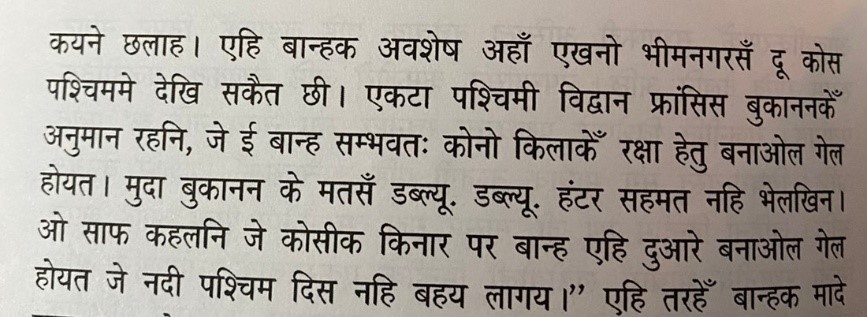
Original Dinesh Kumar Mishra (Dui Patan Ke Beech Mein... 2006): The work of damming the Kosi river in Bihar in India was first undertaken in the 12th century by a king named Lakshmana II. For this work, he received the title of 'Bir' from his subjects, and the embankment came to be known as 'Birbandh'. Remains of this embankment are still visible about 5 kilometers south of Bhimangar in Supaul district. Dr. Francis Buchanan (1810-11) estimated that this dam might have been an outer wall for the security of some fort, as it extended for 32 kilometers along the western bank of the Dhaus river from Tiljuga to its confluence. Dr. W.W. Hunter (1877) disagreed with Buchanan's argument that this dam was a fort's defense wall. Citing local people, Hunter believed that most people did not consider it a fort wall, and according to them, it was something else, but he was not in a position to say definitively. Nevertheless, the common belief is that it was an embankment built along the Kosi river to prevent the river's flow from shifting westward. People also said that it seemed the construction of this embankment might have been stopped abruptly.
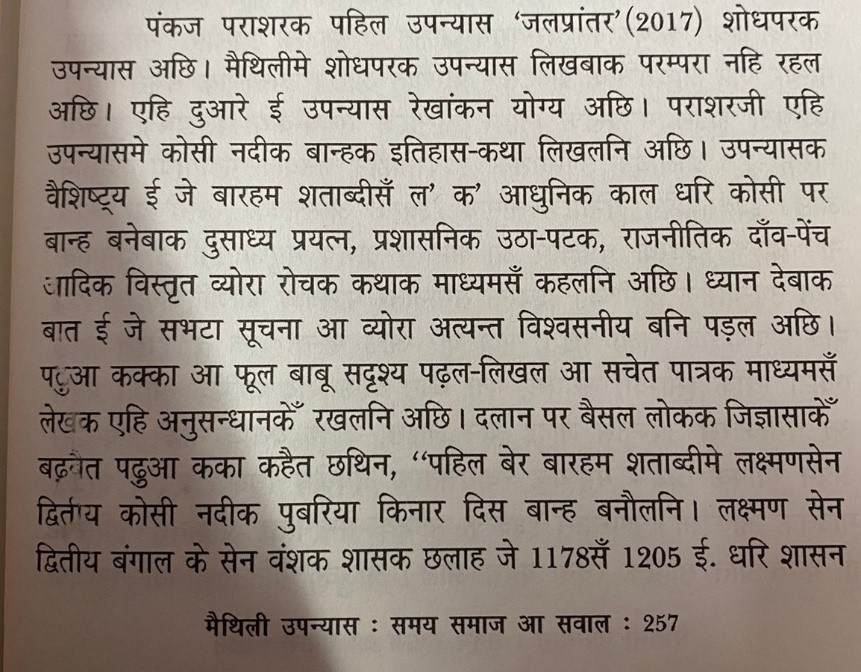
See how the pseudocritic Kamalanand Jha supports the thief novelist. Excerpt from pseudocritic Kamalanand Jha quoting thief Pankaj Jha Parashar (Maithili Upanyas, Samay, Samaj A Sawal p. 257-258):
Thief Pankaj Jha Parashar (Member, Sahitya Akademi's Maithili Advisory Committee) [Jalprantar 2017 (p. 31)]:
Original Dinesh Kumar Mishra (Dui Patan Ke Beech Mein... 2006): A glimpse of the ferocity of the Kosi's flow is seen when Firoz Shah Tughlaq's army was returning from Bengal to Delhi in 1354 AD. It is said that when the Sultan's armies reached the banks of the Kosi, they saw the armies of Haji Shamsuddin Ilyas, who had founded Hajipur and Samastipur, standing ready for battle on the other side. Firoz's armies stood pondering on the banks of the Kosi somewhere near Kursela. The river's speed prevented them from advancing. Finally, it was decided to move north along the river and find a suitable crossing point. The Sultan's armies went almost a hundred kos upstream and crossed the river near Jiyaran, located where the river descends from the mountains to the plains. Here, the river's course was narrower, but the current was so swift that heavy stones weighing five hundred maunds were carried away like straw. Where crossing seemed possible, the Sultan placed rows of elephants on both sides, with ropes hanging from the downstream row so that if anyone was swept away, they could be rescued with these ropes. Shamsuddin had never imagined that the Sultan's armies would cross the Kosi, and when he learned that they had succeeded in crossing, he fled.
Thief Pankaj Jha Parashar (Member, Sahitya Akademi's Maithili Advisory Committee) [Jalprantar 2017 (p. 105)]:
मूल दिनेश कुमार मिश्र (दुइ पाटन के बीच में... २००६):
यह ध्यान
देने की बात है कि
1923
से
1946
के बीच कोसी
क्षेत्र में मलेरिया से
5,10,000,
कालाजार से
2,10,000,
हैजे से
60,000
तथा चेचक से
3,000
मौतें (कुल
7,83,000)
हुईं।
चोर पंकज झा पराशर (साहित्य
अकादेमीक मैथिली परामर्शदात्री समितिक सदस्य)
[जलप्रांतर २०१७ (पृ. १०३)]:

मूल दिनेश कुमार मिश्र (दुइ पाटन के बीच में... २००६):
भारतवर्ष
में बिहार में कोसी नदी को बांधने का काम
12वीं
शताब्दी में किसी राजा लक्ष्मण द्वितीय ने करवाया था और इस काम के लिए
उसने प्रजा से
'बीर' की उपाधि पाई और नदी का तटबन्ध
'बीर बांध' कहलाया।
इस तटबन्ध के अवशेष अभी भी सुपौल जिले में भीम नगर से कोई
5
किलोमीटर
दक्षिण में दिखाई पड़ते हैं। डॉ. फ्रांसिस बुकानन (1810-11)
का
अनुमान था कि यह बांध किसी किले की सुरक्षा के लिए बनी बाहरी दीवार रहा
होगा क्योंकि यह बांध धौस नदी के पश्चिमी किनारे पर तिलयुगा से उसके
संगम तक
32
किलोमीटर की दूरी में फैला हुआ था। डॉ. डब्लू.डब्लू. हन्टर (1877)
बुकानन के इस तर्क के साथ सहमत नहीं थे कि यह बांध किसी किले की
सुरक्षा दीवार था। स्थानीय लोगों के हवाले से हन्टर का मानना था कि
अधिकांश लोग इसे किले की दीवार नहीं मानते और उनके हिसाब से यह कुछ और
ही चीज थी मगर वह निश्चित रूप से कुछ कहने की स्थिति में नहीं थे। फिर
भी जो आम धारणा बनती है वह यह है कि यह कोसी नदी के किनारे बना कोई
तटबन्ध रहा होगा जिससे नदी की धारा को पश्चिम की ओर खिसकने से रोका जा
सके। लोगों का यह भी कहना था कि ऐसा लगता था कि इस तटबन्ध का निर्माण
कार्य एकाएक रोक दिया गया होगा।
छद्म समीक्षक कमलानन्द झा द्वारा चोर उपन्यासकारक पीठ ठोकब, देखू छद्म समीक्षक कमलानन्द झा द्वारा उद्धृत चोर पंकज झा पराशर (मैथिली उपन्यास, समय, समाज आ सवाल पृ. २५७-२५८):
चोर पंकज झा पराशर (साहित्य अकादेमीक मैथिली परामर्शदात्री समितिक सदस्य) [जलप्रांतर २०१७ (पृ. ३१)]:
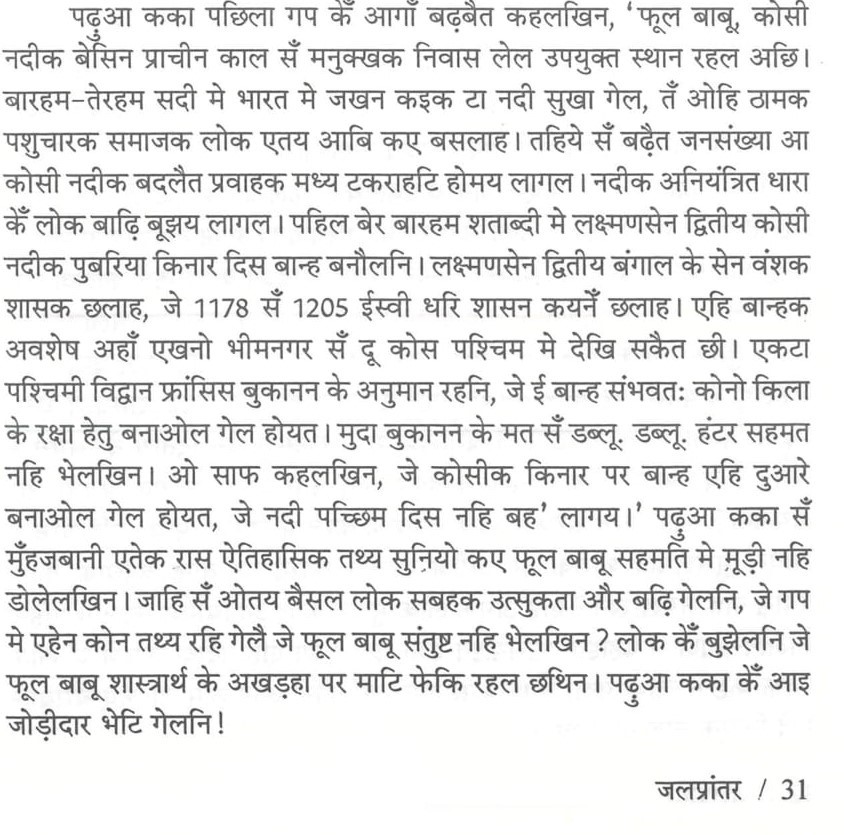
मूल दिनेश कुमार मिश्र (दुइ पाटन के बीच में... २००६): कोसी के प्रवाह कि भयावहता की एक झलकफिरोजशाह तुगलक की फौज के सन् 1354 में बंगाल से दिल्ली लौटने के समय मिलती है। बताया जाता है कि जब सुल्तान की फौजें कोसी के किनारे पहुँचीं तो देखा कि नदी के दूसरे किनारे पर हाजी शम्सुद्दीन इलियास की फौजें मुकाबले के लिए तैयार खड़ी हैं। यह वही हाजी शम्सुद्दीन थे जिन्होंने हाजीपुर तथा समस्तीपुर शहर बसाये थे। फिरोज की फौजें शायद कुरसेला के आस-पास किसी जगह पर कोसी के किनारे सोच में पड़ गईं। नदी की रफ्तार उन्हें आगे बढ़ने से रोक रही थी। आखिरकार फैसला हुआ कि नदी के साथ-साथ उत्तर की ओर बढ़ा जाय और जहाँ नदी पार करने लायक हो जाय वहाँ पानी की थाह ली जाये। सुल्तान की फौजें प्रायः सौ कोस ऊपर गईं और जियारन के पास, जो कि उसी स्थान पर अवस्थित था जहाँ नदी पहाड़ों से मैदानों में उतरती थी, नदी को पार किया। नदी की धारा तो यहाँ पतली जरूर थी पर प्रवाह इतना तेज था कि पाँच-पाँच सौ मन के भारी पत्थर नदी में तिनकों की तरह बह रहे थे। जहाँ नदी को पार करना मुमकिन लगा उसके दोनों ओर सुल्तान ने हाथियों की कतार खड़ी कर दी और नीचे वाली कतार में रस्से लटकाये गये जिससे कि यदि कोई आदमी बहता हुआ हो तो इस रस्सों की मदद से उसे बचाया जा सके। शम्सुद्दीन ने कभी सोचा भी न था कि सुल्तान की फौजें कोसी को पार कर लेंगी और जब उस को इस बात का पता लगा कि सुलतान की फौजों ने कोसी को पार करने में कामयाबी पा ली है तो वह भाग निकला।
चोर पंकज झा पराशर (साहित्य अकादेमीक मैथिली परामर्शदात्री समितिक सदस्य) [जलप्रांतर २०१७ (पृ. १०५)]:
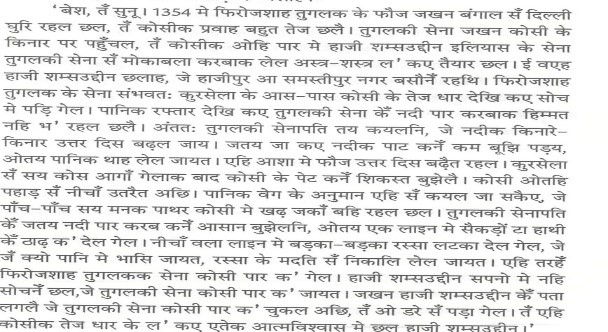
(These are just a few examples. Thief Pankaj Jha Parashar's (Member, Sahitya Akademi's Maithili Advisory Committee) "Jalprantar 2017" is a pirated book, and the entire book is shamelessly filled paragraph by paragraph from Dinesh Kumar Mishraji's books.)
Chapter 2
Gharāṛī (Novel) (1973)
This novel was published by the Akhil Bharatiya Mithila Sangh (Babu Saheb Chaudhary). Babu Saheb Chaudhary also has a foreword titled "Samasya". And Sushil dedicates this novel to his maternal home. In a brief author's statement, he invites you on a journey to a desert, but there are also oases, where date palms and water are found.
The novel begins on the reader's (Pāṭhak Jī) veranda. There are two chests, a stool, two she-buffaloes, a cow, and a pair of bulls. The barren field is growing cactus; the barren land is more attached to the dried twigs—the play of nature!
After setting up all the arrangements, the novelist introduces Ratan, a military man.
Here, one also learns about language. Sushil did not unnecessarily use 'ka' and 'ta' even in 1973. In the PDF, where it appears initially, he has crossed it out with a pen; the later version is correct. In this novel, there is also a love relationship between a Mallah girl and a Brahmin's son. So, does this prove that someone who is proficient in language can also think ahead, and that their subject matter is also forward-thinking? Both of these works were suppressed in the mainstream. Udaychandra Jha 'Vinod' from Dulaha village, who is mediocre and has a reactionary ideology (his deceit regarding Sharadindu Choudhary and Premlata Mishra 'Prem' is recorded in Videha's Sharadindu Choudhary special issue and Premlata Mishra 'Prem' special issue), was accepted in the mainstream. But Sushil, also from Dulaha village, who is far ahead of him in language, thought, subject matter, and literary standard, and belongs to his caste, was suppressed. Why wouldn't he be rejected in the mainstream? The pseudocritics either haven't even heard his name, or they engage in such charades.
Ratan's share of ancestral land (gharāṛī) has been plowed by someone else. Lalbabu has gotten it plowed. His younger brother didn't even take his share; why did Lalbabu have Ratan's share plowed? Lalbabu is ready to exchange it (he has filed a case against Ratan later on, for reasons that will be explained), but Ratan wants this exact share of land; why would he uproot himself and go elsewhere? But this information will be found by digging deeper into the novel's details. Also, Ratan, after his father's death, went to the military and was out of touch with the village, that too when he was fifteen years old. For physical fitness, he claimed to be twenty years old and enlisted. No word from him for fifteen years. His brother Mahadev lives on Lalbabu's mercy, surviving. His mother and younger sister, who used to run errands, were swept away in a flood. His anger is natural. But the reader has to guess the plot; Abhiram Jha talks about a forgotten story. Buchchan, the reader's (Pāṭhak Jī) eldest son. Buchchan is good at playing sarō (a game). He is straightforward. Lalbabu used to understand which bamboo would be good for a dāhā (a type of tool) and would get it made. Just as the reader (Pāṭhak Jī) does not set his pieces (goti), he also has differences of opinion with the reader (Pāṭhak Jī). The novelist introduces the reader's (Pāṭhak Jī) granddaughter, Kumkum. Kumkum will have a big role later; for now, she is crying. Her terrylene frock caught fire and got burnt. The reader (Pāṭhak Jī) is leaving for the hospital. First section ends.
At the Bagmati Kathak Hospital, due to Lalbabu's (Laliteshwar Choudhary) influence, a five-bigha piece of land was given to him. The reader's (Pāṭhak Jī) contribution was physical, not monetary. Buchchan and his youth brigade volunteered their labor. And the reason for this charity? His son was studying medicine in Darbhanga at that time, and he is now at this hospital. Far-sighted thinking! And the reader (Pāṭhak Jī) takes Kumkum to this hospital, where a nurse from the Mallah caste is, and Lalbabu's son, the Brahmin Dr. Binayak, is the doctor. Lalbabu also arrives at the hospital. He is not interested in these matters; his mind is focused on the matter of Ratan, who had gone to the reader's (Pāṭhak Jī) place in the morning. Second section ends.
The third section begins with gossip flowing freely by the pond called Nanu Pokhri. There is a panchayat (village council) meeting to decide whether to reconcile Ratan and Lalbabu or not. The reader's (Pāṭhak Jī) younger son Malay, the one who had brought the terrylene frock for Kumkum, and Lalbabu's younger son Ajit, both have come to the village from college in Muzaffarpur during the summer break. They are both there. Vividh Bharati is broadcasting the Jaimala program by Beheda Rahman. In the PDF, Sushilji has crossed out and substituted Amin Sayani, but Amin Sayani used to do the Binaca Geetmala program on Radio Ceylon; Jaimala for soldiers might be on Vividh Bharati with various artists, and Amin Sayani could do that, and Beheda Rahman too. So we are proceeding with the printed version. The panchayat is being held at the library established in the name of Sundar Jha, a winner of the Dhaut Pariksha, by the Nanu Pokhri. Lalbabu is ready to exchange the land; he is even willing to give two kathas extra, but Ratan wants that exact share of land, and he will go to Tamasa (a river where rituals are performed) [i.e., he is adamant]. Section ends.
Fourth section begins. Ratan's younger brother Mahadev is murdered! Ratan is accused. He flees. But Buchchan testifies in his favor at the police station, saying that since he hasn't been in the village for 4-5 days, how could he commit the murder? He has 4-5 people with him, maybe 10-15. The reader (Pāṭhak Jī) is stunned. Lalbabu is silent. And Batthan Babu is watching everyone's expressions. Batthan Babu had heard Ratan's side from Buchchan, and Buchchan is giving his statement as per Batthan Babu's instructions. A twist within a twist. Section ends.
Fifth section. The Brahmin Dr. Binayak and the Mallah nurse Karuna. Karuna says this marriage is impossible; she is of low caste, a Mallah's daughter, and Binayak is a big man. Binayak disagrees. And he says that what he will do will drive the fear from Karuna's heart. But Karuna slaps him and leaves. However, in the sleeping state, the novelist troubles him by narrating a dream; Binayak also has that love. And Binayak is drowning like a Tamasa (a river) filled with poison. He thinks Karuna is a coward. But the novelist introduces an old man with a stick into his dream, who tells Binayak that the one whom Binayak considers strong is actually weak due to the suffocating norms of society, and he gives him a chakra (discus), a sudarshan (conch), and a trishul (trident), telling him to use them. He says, why not act with courage? What will be achieved with just false promises? Women have no faith in society. But Binayak says his promise is true. He says this while scratching his head. Malay and Ajit take Binayak out for a walk.
Sixth section: After Mahadev's murder, Lalbabu arranged his Shraddh (funeral feast) quite well. But Batthan Babu and the reader (Pāṭhak Jī) are not unaware of the reason for this generosity. They have no doubt about who is behind Mahadev's murder. But they lack the strength to openly oppose it. And meanwhile, Lalbabu also wants to keep these two together and also maintains cordial relations with Batthan Babu. There is a rumor that Santraj's son Ratan has come at night to meet Buchchan. Paragas's father, Saryu Mandal, died two years ago. Lalbabu had paid all the expenses for his Shraddh. That is why Paragas's family is indebted to him. Paragas had passed matriculation; Lalbabu had his fees waived. He had tried to get a grant for a backward class, but Lalbabu twisted his words and kept him close, giving him three bighas of land, but there is no written record. And finally, some humor regarding the welcome of Batthan Babu's in-law—tea was served to him in a glass, but it was too hot; he fluttered like a rooster that had been given too much salt. Sixth section ends.
Meanwhile, Ratan is under the shelter of his friend, Avadhesh, a devotee of Lord Shiva. Avadhesh had run away from Kapileshwar Sthan after stealing something, and after passing middle school, he wrote his name at Kapileshwar High School. Ratan goes to the Bhootnath temple at Nimtala Ghat to seek refuge with Lord Shiva. He meets Avadhesh, who lives with his wife Sunita on Bhupen Bose Avenue. Ratan is in rags! The big officer Avadhesh is standing on the stairs, capturing the sight of Ratan's poverty. Seventh section ends.
Ratan and Avadhesh go hunting for wild fowl together. There is a warrant against Ratan. He needs bail. A letter arrives, from Avadhesh's brother. They wanted to get Dr. Binayak married to their sister Prema; Lalbabu was also agreeable. But now Avadhesh has to think. Binayak is Binayak, but Lalbabu? Ratan says, marriage is with the girl, not the family, but one also has to consider the family. The letter says Lalbabu wants the matter settled quickly. This raises suspicion. Earlier, he never spoke openly due to the lure of money. Eighth section ends.
Karuna comes to the reader's (Pāṭhak Jī) courtyard with Kumkum; the weather has become pleasant. Lalbabu asks Karuna to request a transfer to another place. She signs the application. Lalbabu leaves. Karuna cries. Seeing her, Kumkum also cries. The reader (Pāṭhak Jī) arrives. He asks Kumkum why she is crying, and she reveals the secret: Lalbabu had been pressuring Karuna, making her sign some paper. Section nine ends.
Conversation between Karuna and Binayak. Karuna's gaze falls on Lalbabu's photograph. Binayak is firm. Section ten ends.
Conversation between the reader (Pāṭhak Jī) and Batthan Babu. The reader (Pāṭhak Jī) has understood something. Before giving Karuna the job, Lalbabu used to talk about some condition with the Mallahs. When asked, he avoided it, saying he wanted to sow jeera (cumin) in the Digrasari pond. But no pond was given to the Mallahs by Lalbabu for jeera cultivation. So what was the matter that the Mallahs and Lalbabu understood? Karuna's education was from 'Catholic Church School' and 'Chapman Girls School' in Muzaffarpur. Kumkum had asked the reader (Pāṭhak Jī) whose daughter Karuna Didi was. Didi used to tell Babu that she was his daughter and also gave him money. Did Karuna sign a document? The reader (Pāṭhak Jī) asks Binayak to ask Karuna. Binayak asks her, and she cannot refuse. And then conversation between Binayak and Karuna; Binayak does not let his outburst fall on Karuna. Section eleven ends.
On Avadhesh's recommendation, Ratan is a Security Advisor in Kolkata. He goes to Muzaffarpur for the court date but does not go to the village. He meets Shéfali with Avadhesh. During the conversation, Shéfali says Avadhesh gave jobs to many Maithils, but they all keep criticizing him. Shéfali says her uncle is a lawyer; he says Ratan will win, but the real murderer must also be found. Ratan believes the real murderer is Lalbabu's henchman, Paragas. Avadhesh tells Ratan about another letter: Binayak has fallen in love with Karuna and wants to marry her. Shéfali's father is Ratan's Security Officer. Shéfali's uncle is Kamal Sarkar, a lawyer. Shéfali's father, Rai Ji, is Maithil, and her mother is Bengali. Shéfali has also written several books in Maithili. The incident between Shéfali and Ratan! Section twelve ends.
Lalbabu sends Karuna's transfer letter, but Binayak sends Karuna on leave and has the letter returned by the postman with 'Not Available' written. The postman is a young man whom Binayak had tried hard to get a job. Lalbabu tries to get rid of Karuna through Paragas, but his wife is disturbed by hearing two words, "See, you'll be destroyed." Malay and Ajit are in the village during the hot summer. Paragas goes with four men, but Karuna fights back fiercely and frees herself. Hearing her scream, Malay, Ajit, and the dresser, Siricharan, arrive. Karuna recognizes Paragas among the four. Section thirteen ends.
Karuna's transfer letter was returned once. Now Lalbabu is looking for some other means; he is wondering what to do with this stubborn woman. The lawyer said Ratan will be acquitted. If they get Karuna and Paragas married, the matter will be settled. He returns home. His wife believes that the delay in Binayak's marriage is due to the thirty thousand rupees and a car demanded by him. Section fourteen ends.
Thanks to Mr. Rai, Ratan got a job and bail. Lalbabu's wife gets a hint that Karuna is Ratan's sister, Munia; she has a birthmark on her wrist, just like the one Paragas's mother mentioned. Lalbabu regrets why he got stubborn for money; he could have gotten Binayak married to Avadhesh's sister. A conversation takes place; the wife says Binayak and Karuna are already married. Lalbabu pushes her, but Binayak steps in between, and Lalbabu retreats like a scalded cat. Section fifteen ends.
Karuna moves into the staff quarters with Binayak. Batthan Babu, the reader (Pāṭhak Jī), and Mansur Nadaph go to appease Lalbabu. Paragas was always Buchchan's follower, but where is he now? Karuna's transfer letter arrives again, this time by special messenger. Karuna receives the letter. Binayak is furious. He calls her low, a scoundrel. He says, where will caste and religion go! He calls her low! A whore! But upon hearing the word 'Pranesh' (Beloved), Binayak melts. Karuna puts a folded paper in Binayak's hand. Binayak reads it and feels ashamed, apologizing. Karuna resigns. The news spreads. Lalbabu starts eating and drinking. He says if Binayak comes home, he will leave the house. Lalbabu even goes on a hunger strike. He asks Paragas to play his final role. Section sixteen ends.
The final section is seventeen. The day of Durga Visarjan (immersion). For Durga Puja, three plays are staged: two in Maithili and one in Hindi. Today's Maithili play is 'Kuhes'. Binayak refuses to play Ramkumar's part; he plays the doctor's part. Ajit plays Ramkumar, and Malay plays the highly educated youth Shankar. Buchchan plays the bride's father, Subansh. Playing a part doesn't make one that; Buchchan is herding everyone. After the court date, Ratan also comes to the village at Avadhesh and Buchchan's request to see the Durga Puja. There is a rumor in the village that Karuna is not a Mallah's daughter; Ratan talked to her a couple of times, and he guesses that she might indeed be his sister Munia. The women's gossip makes Ratan ponder. Ratan stays with Buchchan. It's around four o'clock; the play is about to end. The immersion was delayed. Karuna brings her father every year; he has also come this time. Paragas is behind Ratan. At the end of Navgachuli, there is dust; he is hidden behind a tree. But he falls into a trap set for Lalbabu; Ratan was behind him. The truth is revealed; Lalbabu is taken to the hospital. Then, the revelation of secrets and repentance. And the drama of Vijayadashami ends.
Chapter 3
Gāmbālī (Novel) (1982)
Everyone's eyesore, Gāmbālī, is gone, and the thorns too!
Those who liked her, those who didn't, and those who were indifferent—all three types are happy. Who will perform her last rites? Yadav society or Brahmin society? People from Yadav society and Brahmin society go to the landlord, Sonmani Jha. He is walking step by step, engaged in consultation.
The Yadav society performs Gāmbālī's funeral rites together.
People from the Goar Toli started calling her Gāmbālī (village girl), and then people from the Babhan Toli, Kayasth Toli, and Jolaha Toli also started calling her Gāmbālī.
Gāmbālī's husband was old. She was his third wife. There were no children from the first, so he remarried, and there were children from the second, and also from the first. And then the third marriage was for pleasure. There's a saying of Babu Pairookh, how many wives can one have?
The people made Gyanchan Yadav, i.e., Gyanchanma, a murderer; he went into her house by force and then created a stir in the village.
Gāmbālī remained alive; her will to live became even stronger later. She lived with great pride, not caring about anyone. For those who saw her as a whore, she was nothing. She laughed and joked with anyone who had a sister-in-law relationship with her. The promotion of calling her Gāmbālī started from the Goar Toli and spread throughout the village.
But Gāmbālī had no connection with her old in-laws' family in this village. However, in terms of food and lifestyle, she was different from the Brahmins.
After her death today, she has no shortage of admirers. She came with pride and left with pride.
Gāmbālī was married to a wealthy, arrogant old man. She was his third wife. The old man married a second time for companionship, and there were children from the second and first. The third wife was for pleasure, just for show.
The cunning people tried to drive her away and made Gyanchanma into a murderer.
And the novelist begins with Gyanchan Yadav's story.
He called elders 'Baba', 'Kaka', 'Bhai', and younger ones 'Baua', 'Bachcha', 'Nunu'. There was no courtyard where he did not enter. He would address women as 'Dai', 'Kaki', 'Bahan', 'Bachiya' until his mouth was sore. But when he went to the courtyards of young women, it was something to see. If an old woman persisted, he would enter the courtyard of a beautiful woman. Women of the category of 'Babi', 'Mai', 'Pius' used to say, 'How does he practice medicine, being so shameless?'
Gyanchan was a lover of songs. He was very fond of foreign dances and nautanki (folk theatre), which was considered an art form for the young, but the noble and the new-generation gentlemen would sit in the front. He knew all the songs of the foreign dance by heart. He could sing Vidyapati and Nirgun Nacari in the same way, which pleased the Brahmins; his village was a Brahmin village. He also remembered the bhajans of Mira and Kabir. But for the songs and dances of Jalim Singh, his mind would race, he would feel hesitant, but he didn't dare.
His medical practice brought him fame, but many people were jealous. Then he felt like buying a car (harmonium), which his grandmother had saved up for a lifetime, in the form of silver coins. The harmonium, a watch, and a horse came from the Sonpur Mela. These things caught some people's eyes. The landlord's own nephew, Gena Jha, was Gyanchan's close friend and became an expert at riding the horse. There were a few watches and a few harmoniums in the village, but whenever there was an occasion like kirtan or asthajam, Gyanchan's watch and harmonium would be used. If someone's child had a naming ceremony, his watch would be present at the soiree. His influence extended over ten villages.
Meanwhile, Gāmbālī's pain increased. Gyanchan wouldn't go there riding a horse, just had words. Ramadhar Agilesua was there. But Gena Jha roamed everywhere on horseback. But Gāmbālī praised his watch and requested to see the horse. So he brought the horse for her to see. But then other people also gathered there. Had Gāmbālī been possessed? People crowded to see her body. People were covering their mouths. Then Gāmbālī regained consciousness. Gāmbālī tells Gyanchan that she has stomach pain, it's not a ghost. Gyanchan gives her new medicine, telling her to throw away the old one.
Then begins the story of Kiran Dai's Dwarika's Guru Maharaj. Kiran Dai is confused about where to place Guru Maharaj. Some people had come for the harmonium; Gyanchan has to arrange a 'jogar' (offering) for the Guru Maharaj as per tradition.
Kiran Dai, the niece of Kantir Babu, is a child widow. Before the consummation of her marriage, her bangles were removed; she became an ascetic, spending her eight days (a ritual) at Kapileshwar. It is said she redeemed her lineage. She meets saints. Saints from Vrindavan and Dwarika praise her greatly.
The Maharaj from Dwarika is wonderful, with a simple appearance, but he does not please her father. He casually said something, but Maharaj kept singing bhajans and moving on, he wouldn't stop. Kiran Dai's voice is so sweet that Maharaj must have liked it. People were pleased. Her father apologized, and Kiran Dai was happy. Then a description of Maharaj. He is not from Dwarika but from Vrindavan. He is a lifelong celibate; he left Vrindavan but not permanently. With such a body, he cannot lead a wayward life. Meanwhile, Gāmbālī was staring intently at Gyanchan, and the landlord was watching her. Gyanchan felt he was caught. There were three or four other child widows. Maharaj sang Bindu Ji's bhajan, then Sur, and then Mira's.
Gyanchan became thoughtful. Would Gāmbālī also become like Kiran Dai one day? There is a kind of energy in all child widows; she has something like Kiran Dai.
Kiran Dai wouldn't become a Sakele; she kept her faith. Ghosts often possessed her.
If not that, she would become a Parmeshwari; the knots in her body could drive anyone mad. It was a matter of a moment or two, then she would wander around Kapileshwar, Videshwar.
If not that, she would become a Ratni, who is fearless in her father's house, protected from all sides. But men would set fire to her, their anger is not taken. So Ratni fell. Ratni was broken; she didn't have the courage to face society.
No, Gāmbālī wouldn't become anything. She is invincible. She would never give in. She got up. She is young. No one can catch her. In the grasslands, the mountain stands still; the stalk flies. He left with the harmonium. That night, Gāmbālī couldn't sleep. Gāmbālī's father was a Pandit; he had taught her to read and write. Sometimes she would read her brother's history and geography books.
Fifteen years had passed since the abolition of the zamindari system, but the tradition of playing the game of sarō in the village continued. The village's khalifa (head of a group) was Dafedar Jadab. Gyanchan was the khalifa's nephew. All of the landlord's (Sonmani Jha) people were the khalifa's followers. Gyanchan was more cunning and agile than all his associates except for a couple. The choupal (village meeting place) would gather around Gyanchan. He would go to Madhubani-Darbhanga to buy medicine and would read newspapers. The India-China war was happening. He would tell everyone about it.
The paddy was being harvested; piles of paddy were spread in the courtyards.
The landlord's nephew, Ramadhar, was more envious of Gyanchan's horse, watch, and harmonium than anyone else. Should a young man wear a watch or cut grass? The matter escalated; Gyanchan punched and landed five or six blows. Gena Jha restrained Gyanchan, the khalifa restrained Ramadhar. The khalifa told Gyanchan not to come to his doorstep—"You are a Dom, I am a Chamar." Ramadhar's side. The khalifa was like a leaf in the wind; he understood the landlord's mind. The khalifa, as a mediator, took Ramadhar and went. The matter spread like gossip. Sonmani Jha scolded his nephew, but the matter was not forgotten. He had laid hands on a Brahmin; the village would become a mess; would there be a 'bhar-changera' (commotion) or a 'bhar-daur' (excommunication)? There would surely be an inquiry.
Sonmani thought: Gyanchan is in everyone's heart, including his own. But when he started to weigh Gyanchan, he couldn't find a single grain of hope. That one grain had been crushed in his eyes. And the decision was made: to crush the snake's hood. It's better to suppress the conflict. Gyanchan's father had taken a stubborn animal under his wing, and it had become a bull. From that, Gyanchan's lineage had grown. Now, with Gāmbālī's medicine and support, it had grown further. No matter how much water and stones he threw, Gyanchan would just take a stroll around the village.
Now Gyanchan couldn't bear to come every day; everyone's behavior had changed. People were looking for a reason to quarrel. They were waiting for him at one place, watching from another. He was making many packets (of medicine) in Gāmbālī's courtyard. Why is Gyanchan making so many packets? Did we have a fight? Only we are the ones investigating—Gāmbālī asked. An intimate conversation. This is what is poisoning me—Gyanchan said.
If one hasn't seen Rama, what can one see of others? Gāmbālī retorted.
Gāmbālī asks about his marriage. He replies—Marriage happened and it didn't—marriage happened by a certain measure, that's how it is in youth. There's an engagement between us, maybe it will happen somewhere—Gyanchan says.
Gyanchan is a doctor. Gyanchan tells everyone his matters, because the relationship between a doctor and patient is like that of father and son—Gyanchan says.
Is there no other relationship?—Gāmbālī asks.
The one who made even the brave tremble during zamindari times, how did he become so soft-spoken? A sign of taking the bait...
One night, one bigha of Gyanchan's paddy was cut. The 'Gangajali' paddy was very beautiful.
Theft does not happen in Rampur village.
But this...
People were surprised; the dogs didn't bark.
But Gyanchan did nothing in the morning.
They were waiting for the right time, but there was no opportunity to provoke Gyanchan. The matter was building up, but Gyanchan broke the buildup at the very start.
Dogs bite strangers, jackals bite those they know, and women and thieves bite everyone.
Gyanchan took three or four people and started hiding in the field.
But one night he fell asleep. A woman named Kari came to ask for a black lota in the late night. Kari is a well-known woman from the landlord's house. She has been around for a long time. He didn't trust her. He kept her in a bind and took a whip and a stick himself. The others took spears and axes and left. The paddy was being covered with mats. There were three or four of them and fifteen or twenty others. Gyanchan's presence of mind was amazing. Attacking now was not right; they too had weapons. He planned to attack when they lifted the load and left, catching Ramadhar and the others. People who steal crops are not thieves; they would not face him.
Ramadhar was caught. Parao Jha got him released, and there was talk of the police and the complexities of law.
Later, Gyanchan got four or five blows, but Gena Jha and Parao Jha gave them.
The khalifa's son, Baiju, started sitting with the Brahmins. A fight over a bamboo strip started between the khalifa and Gyanchan. The khalifa gave in, but Baiju was not one to agree.
Sonmani Jha (the landlord) and Satajib Jha were outwardly arrogant but inwardly weak.
The landlord grabbed Gāmbālī's wrist and put a bundle of money in her hand. Gāmbālī threw the bundle into the stove.
Gyanchan sold his horse.
Then the novelist talks about Gāmbālī's parental home and society.
A saint didn't let a Bhil woman touch the water of the Pampasar, fearing pollution. The Pampasar dried up. Purushottam Ram allowed her to bathe there; the Ganga had mixed into it, and the water of Pampasar became nectar.
Gāmbālī came out of her courtyard and went to Gyanchan. She placed her temple against Gyanchan's chest. Gyanchan's grandmother watched everything. Gāmbālī returned. By dawn, the matter had been whispered about. The landlord pushed Gāmbālī, and she was shoved into Gyanchan's doorway. And Gāmbālī became Gāmbālī that very day. Gyanchan filled the Panji (record). Gāmbālī's all pain vanished then. Gyanchan opened a middle school in the village on the bullock's back. He also got the road leveled. Rampur started being talked about in surrounding villages. The zamindari system ended, and the wealthy people started buying up fallow lands and the landlord's mango groves for a pittance.
That day was the 'Ghadi Puja' (worship of the watch). A dispute arose over the strip. Gāmbālī became a widow for the second time that day. The landlord and the khalifa had to spend twelve years in jail.
No one understood Gāmbālī's story in such detail; everyone hears about her after her death.
Sondai's father sold her to a man from Dakshinaha when she was nine years old. She left her husband and remarried. The first husband came, but the college-going and foreign-returned people of the village drove him away. Satajib Jha's son married his girlfriend... Ramadhar's son...
Two or three Jadabs are handling Gāmbālī's funeral rites. Gāmbālī has a fifteen-year-old son. For the funeral pyre, seven men are needed. The word spreads: Ramadhar's son, then Baiju's son, and then others start joining. Bamboo is being cut from the 'Jhagraua Beat'. The trees Gyanchan had planted have now become someone else's. The funeral rites are performed there. The library will be named 'Gāmbālī Smarak Pustakalaya' (Gāmbālī Memorial Library).
Chapter 4
Bhāmatī (Drama) (First staging 1991, Publication 2013)
Preface: Sangita Menon writes: Two major sub-schools of Advaita Vedanta emerged after Shankar: Bhāmatī and Vivarana. The Bhāmatī school is named after Vachaspati Mishra's (9th century) commentary on Shankar's Brahma Sutra Bhashya, while the Vivarana school is named after Prakashatman (10th century)'s commentary on Padmapada's Panchapadika, which itself is a commentary on Shankar's Brahma Sutra commentary.
Maya is responsible for the creation of the world. Avidya (ignorance) is responsible for confusing the distinct existence of the self (Atman) and the non-self (Anatman). Avidya conceals Brahman and creates the world. As a result, the individual (jiva) acts as an agent and experiencer in the limited world. The differences in doctrine between the two sub-schools of Advaita Vedanta can be understood through their different interpretations of the nature and locus of Avidya and Maya. Shankar considered Avidya to be beginningless. He believed that investigating the origin of Avidya is a process based on Avidya itself and therefore futile. However, Shankar's disciples paid more attention to this concept, giving rise to the two sub-schools. The main issue distinguishing the Bhāmatī and Vivarana schools is the nature and locus of Avidya. According to the Bhāmatī school, the jiva (individual self) is the locus and object of Avidya. According to the Vivarana school, Brahman is the locus of Avidya. The Bhāmatī school believes that Brahman cannot be the locus of Avidya; rather, as Ishvara, He controls it. The individual's ignorance performs two functions: it conceals Brahman and, through projection (vikshepa), creates a separate world. Mula-Avidya (primordial ignorance) is a universal ignorance equivalent to Maya, controlled by Ishvara. The Vivarana school believes that since Brahman alone exists, Brahman is the locus and object of Avidya. Through epistemological discussions, the unreality of duality between Brahman and the world is established. The Vivarana school answers the question by stating that Brahman is both "pure consciousness" and "universal ignorance," claiming that valid experience (prama) in the everyday world is considered Avidya, while pure consciousness is the essential nature of Brahman.
[Sangita Menon, National Institute of Advanced Studies, Indian Institute of Science, Bengaluru, India <https://iep.utm.edu/advaita-vedanta/>]
Vachaspati Mishra discusses the Brahmin's connection with the world and differs from Shriharsha. He co-existed more peacefully with the Naiyyayikas (logicians) than Shriharsha did, considering Nyaya capable of explaining worldly reality and Advaita capable of explaining transcendental reality. Vachaspati also wrote a commentary on the Nyaya Sutras. Thus, like Dharmakirti, he was esteemed in both Advaita and Nyaya, and like Shankar, in Samkhya and Advaita—meaning he was respected in two philosophies each. However, this peace was broken by Shriharsha's Khandanakhandakhadyam. Shankar Mishra (in Bhedaratna) even stooped to incivility: "Only the Tarkikas (logicians) are active for the protection of Bhedaratna, so we, the Vedantins (Advaitins), are cutting off the heads of these thieves." (This Shankar Mishra is different from Adi Shankaracharya—a disrespectful target at Adi Shankaracharya).
The Drama Bhāmatī
Thus, it is established that the elderly Vachaspati was inclusive. Therefore, the aggressive and eccentric portrayal of him in the drama Bhāmatī at some point does not align with his philosophy.
The drama focuses on Bhāmatī. There is a feminist discourse (especially in Shambhavi; in Bhāmatī as well, but due to Bhāmatī's suicide attempt, it falls into a lower category within feminism). Social anomalies are also depicted. The dialogues are suitable for the staging of the play. There are 11 characters, including Bhāmatī, with only one other female character. Considering the limited number of female actors or men playing female roles, this is acceptable. The first act begins after the death of Vachaspati's parents. There are descriptions of the scene, costumes, and stage setting. Bhāmatī's heart fills with joy upon hearing the news that her husband Vachaspati has gone to visit the birthplace of his guru Shankaracharya and will also see his places of work. A villain, Purandar, also appears; he wants to make some money, open schools, etc. Later, he becomes even more audacious.
In the first act, Bhāmatī is 25-26 years old.
The second act also begins with descriptions of costumes, stage setting, and scene. The second act is set 15-16 years later. So now Bhāmatī is 40-42 years old. Vachaspati appears in this act, seeing Bhāmatī for the first time, as he was engrossed in his scholarly work.
In the third act, Bhāmatī is shown giving a letter. In the letter, she blames herself for distracting him, causing the delay in his commentary on Shankar's Brahma Sutra Bhashya. She is about to jump into a pond, but this is not described in the play. In the next scene, with the entry of Vachaspati, who pulls out a completely drenched Bhāmatī from the pond, it becomes clear. Therefore, he named the book Bhāmatī. And the play ends.
In folklore, there is a description of how, when the oil in the lamp ran out, she made a wick from her sari, and after completing the book, upon seeing her naked, he named the book Bhāmatī for her sacrifice. However, perhaps for staging purposes, the playwright made this change. Also, Bhaskaracharya named his mathematical text after his daughter, Lilavati, but in that book, the questions are often addressed to Lilavati. [O Lilavati, intelligent girl, if you understand addition and subtraction, tell me the sum of the numbers 2, 5, 32, 193, 18, 10, and 100, and also tell me what remains after subtracting from 10,000.]
Chapter 5
Asmitā (Short Story Collection) (2016)
Asmitā is a collection of short stories. While reviewing the mainstream Maithili stories, I inadvertently remember Sushil, seeing the weakness in the craft of mainstream story writers. Attempts have been made to suppress Sushil due to the weakness of Maithili criticism. Mainstream story writers, who do not even understand the meaning of a short story, kept wandering in literature devoid of readers, and Sushil was forgotten.
Baghotiya
'Baghotiya' demonstrates how fake news is spread, and Bihari is brought in and then disappears. You don't even realize why the Bihari came and where he went. Kites fly in the sky, but the one flying the kite is someone else. Baghotiya (a bird of prey) was lifting children; the issues of land, occupation, votes for two rupees, the vote machine. And what was Baghotiya? Nothing. Why nothing? Look at the craft of the short story 'Titait-Bhijait'. See how it progresses, how the story seizes control of the kite-flyers, exposing them. A father is a father indeed. While listening to the story of Baghotiya, it unravels all modern problems. Baghotiya is Sushil's best story.
My Latest Photograph
Even in my latest photograph, at the editor's insistence, the author gets his photo taken; a bio is needed with the photo. But that storywriter describes his social and economic circumstances.
Prem-Prasang (Love Affair)
In 'Prem-Prasang', the conversations between husband and wife discuss all kinds of matters related to love. 'Sahayatri' and 'Moh' also belong to their own realm. Through the medium of people from different fields, I have described various small problems and emotions that we experienced not today but twenty years ago.
Prem Ne Baḍi Upajay (Love Does Not Grow in a Garden)
"Her face, filled with smiles, white as the Colgate toothpaste model, with a row of pomegranate seeds-like teeth, her unwavering eyes resting on me."
Now, a mainstream children's literature writer, awarded by the Sahitya Akademi, would call pomegranate 'anar' [Anar – Children's Short Story Collection (Maithili) – Author Narayanji; Sahitya Akademi Delhi Children's Literature Award 2024 <https://sahitya-akademi.gov.in/pdf/Pressrelease_BSP-2024.pdf>]. And after the Colgate toothpaste model, describing pomegranate seeds with such finesse can only be done by a story writer of Sushil's caliber. You are right, this excerpt is from the best Maithili love story, 'Prem Ne Baḍi Upajay'. Love does not grow in a garden, nor does a love story.
"Whose fault is it in the end? This is just a game to be played. If we don't all play, the world will stop playing?"
Pipani Par Nor (Finger on the Lip)
Here, the story begins with a morning walk. The D.I.G. Sahib communicates through gestures. The fruit of action, releasing the new recruits into the forest; their 'Vande Mataram' will play. The D.I.G. Sahib says, when you take off the uniform, you become a human; when you wear it, you become a demon. And all the other elements that a modern short story should have.
Pusht.. Pusht.. Pusht (Generation.. Generation.. Generation)
It's the same family affairs. In the village, Asgar the old man and his wife; their children are outside. The story weaves this with artistic craft. The story begins with the Ramayana and ends up somewhere else entirely.
Ekta Kalakar Ki Atmahatyā (An Artist's Suicide)
When the artist gave up art, it was a suicide. And why did he stop painting?
Gharmaṅhā and Sanakirbā
'Gharmaṅhā' and 'Sanakirbā' are stories of the middle class. In 'Gharmaṅhā', a working man's wife seems upset. In 'Sanakirbā', amidst the chaos of the house, there is terrorism, undivided India, and the 'Sanakirbā'.
Gām Sadhbā Hoit Achhi (The Village is Getting Settled)
A story in epistolary style. After retirement, staying in the village to serve it. Medicines, alcohol, feminism, and along with the son and husband. The character of Praveer's mother is the strongest. Some politics of business. Later, it turns out that it was the politics of another medicine shop owner.
Asmitā
Asmitā is the title story. A story of women's empowerment. Just as a woman village head merely signs papers while her husband does all the work, similarly, the woman ward member only signs under coercion. But Minakshi now refuses to do so; she is with other women members and a male member. 'Bhokaṭa' is the story of the widow Savitri and Mantor. 'Nirmal Pramanik' is also there. The real issue is that even in the 'Jaṛiāoṭhā' (community gathering), there is the politics of profit. Later it is revealed that it was the politics of another private tutor's shop. Just like in 'Gām Sadhbā Hoit Achhi', it was the politics of another medicine shop owner. 'Asmitā', 'Bhokaṭa', and 'Asal Bāt Jaṛiāoṭhā' are three weak stories. The story writer seems tired.
Bāt Tākait Ekta Sehantā (A Hawk Waiting by the Road)
Discontentment, Ramanu, the village school. Rabbi, Bhadaai, Kaushiyar, but crops grow in the field all year round. It is neither Rabbi nor Bhadaai; it is cash crop. But the teachers in the village school do not come; those who do come, come only to sleep. But the buffalo's application was approved; the condition of schools is the same across the country.
Mātsarya (Jealousy)
Ramalal got a payment, two five-hundred rupee notes. Should he recount them? The Payment Babu didn't recount them in front of him. But later, he found out that there was one extra five-hundred rupee note. Should he go back and give it? The narrator skillfully portrays his mental state as the story progresses.
Vigyāpan Karāmāt (The Magic of Advertising)
An agarbatti (incense stick) advertisement comes on TV every day. One for ten rupees, expensive. Panditji's daughter wants it. See the magic of advertising.
Masjid (The Mosque)
Sushil's most discussed story. Devkant's guru has to go far to offer namaz. Devkant decides to build a mosque in the village for his guru, with everyone's cooperation. Devkant tells the journalist—Leave the Ram Mandir in Ayodhya to those people. But they won't leave it, know that... There have been many such examples in the country. Does it make any difference?
Haḍtāl (Strike)
Bhola passed matriculation. He stayed at the 'adda' for a few days, then left the party. Both brothers have two shops; he also wants to open a good shop. For that, he needs capital. So he opened a 'Chah' (tea) shop.
Today there is a strike. Everyone has been threatened not to open their shops. But this shop is open, just a shutter is down. The people from the government party praise him; they see those who are not opening their shops. They have tea and leave without paying. Then the police come, have tea, and leave without paying.
Then both parties come one after the other.
A pipe gun bullet hits him; he dies. In the evening, a silent procession is taken out in his mourning.
Saḍak (The Road)
A road is being built in the village. But those whose houses fall on the road are protesting. The benefit of the road is that it will lead to the village. A meeting is held. The road will go through the village from end to end. A decision is made. Everyone starts thinking: who will buy a rickshaw, who will run a jeep on hire? If a bus stop forms near the school, some people think about opening shops and a flour mill. Sukru could open a 'Chah' shop. There is great shame in keeping buffaloes; some say it's a 'Naath Kasu' issue, people grab onto caste. He has traveled to Assam and Kolkata several times. But Lambodar Babu...
The road doesn't get built. Well, half a life has already passed.
Katahu Nahi (Nowhere)
The Chaltar (a person) is walking with a limp; he has come out after many days, looking around. The village seems new, like a different village. August 15th, inauguration, Vande Mataram, one end of the rope is placed in Chaltar's hand. One 'thonga' (jute bag) is given to him, another is given. Chhote Babu had passed away; he had told Pritam two days ago to be present on the 15th of August, but Pritam had gone off somewhere with some sister yesterday. He would understand everything here; such things are not hidden. The body shivered.
Sabta Rehal-Khehal (Everything is Ruined)
The ten cars, gossip, then a robbery. Then the R.P.F. arrives. These passengers come once or twice a year; the ten cars are all ruined.
Uttarapaksha (The Subsequent View)
Chapter 1
Theory
Apart from Marxism, other contemporary theories remained distant from politics. However, contemporary theories brought a revolution in philosophy, if not in politics.
Marxism criticizes social reality and makes the dialectical system the basis of its interpretation.
Freud considers all humans to be mysterious. He chooses a literary work for analyzing the author. Neo-Freudianism emphasizes the primacy of cultural elements over biological ones.
Neo-criticism is based on the detailed description of the work.
Now, in philosophy, mathematics and science have become limited to mathematical logic. The study system of philosophy's induction (from particular to general) and deduction (from general to particular) moved towards the analytical system.
Existentialism, humanism, progressivism, romanticism, sociological analysis—all these have preserved their existence by merging into the synthetic system of criticism. Psycho-analysis, due to its emphasis on scientificity, has preserved its existence like the dialectical system.
Post-modernist perspective: Criticism of the totality of scientific knowledge, truth-untruth, description from each one's own perspective, the end of self-centered humor and the sense of good-bad gradually fading, no certainty about when truth becomes untruth, surface-level thinking, not exactly optimism but not pessimism either, what exists is matter-of-factness, the perspective that a thing can be thought of not in one way but in many ways, lack of belief in cause, control, and planned outcomes, rather more belief in outcomes due to coincidence. Democratic and feminist perspectives, along with ideologies like the red flag, and humor and satire as symbols. Post-modernity brought to the fore the issues of many communities and women who were marginalized from the mainstream due to globalization. It opposed ideology and universal goals but could not provide any alternative. Post-modernist thinker Jacques Derrida fragmented language and established that the fragmented parts are dependent on many different bases, and without understanding them, we cannot grasp the meaning of language.
The analytical philosophy of positivism analyzes not objects but linguistic statements and concepts.
Analytical or logical positivism and existentialism were born as a reaction to science. This clarified the ambiguous view of science.
In phenomenology, the given of consciousness is studied in its given form. Experience is the observation of a specific mental fact. This is a means to see the object in an absolute and pure form.
In existentialism, man—only man exists. He is nothing apart from what he creates. He is condemned to be free (Sartre).
Through Hegel's dialectics, emphasis was placed on determining the quality of process and judging existence through the infinite interrelation of analysis and synthesis.
Quantum theory and the uncertainty principle have also influenced modern thought. The internal and external processes behind the appearance of reality are made possible by the exchange of small elements of force-energy. The uncertainty principle necessitates determining state and form through estimation.
The hypothesis of a universe with more than three dimensions and Stephen Hawking's "A Brief History of Time" are eliminating the existence of God, because the concept of the death of God has also emerged from these. The "God" particle is an attempt to explain the beginning of the universe.
Post-structural methodology connects language meaning, word, its meaning, not with grammatical rules, but with the process of meaning-making. It holds different meanings for all types of individuals and groups. There is no ultimate connection between language and the world. A word and its text do not have a final meaning or a specific meaning of their own. Modern and postmodern logic, reality, dialogue, and exchange of ideas gave birth to modernity.
The new left-wing movement emerged in France. Ideologies like nihilism and anarchism also emerged. These modern thought processes were based on distrust, stepping outside their faith and concepts.
Then began the interpretation of hidden meaning in the text in the context of place-time, and language was made a medium of play—Language Game (Wittgenstein).
Capitalism was born from the industrial revolution. Now, in the post-industrial society, the importance of information and communication has increased over production.
History may not have ended, but traditional history has ended. State, class, nation, party, society, family, morality, marriage—all are being redefined. Many institutions, due to the consequences of constant change, have become fragmented and context-less.
Michel Foucault says—knowledge and truth are created. Deleuze and Guattari say we desire through the other because we are desire machines.
Mikhail Bakhtin takes language as a form of social action. Russian formalist thinkers consider literature merely a specific use of language.
Jean-François Lyotard says—the authenticity of truth and history is only virtual. Baudrillard says—advertising and television have erased the distinction between truth and the virtual. Both are key postmodernist thinkers.
Lacan's specialty is that he applied linguistics to Freud's method. He says the structure of the unconscious is like a language. When a child learns language, a signifier is taught for a signified. Desire, error, and the Other are three facts Lacan presents well. Desire is both need and demand, but it cannot be fragmented into these two forms. Error and emptiness appear in the description of the Other. The subject is a fleeting effect of meaning, and it occurs with the Other when it becomes virtual and becomes the cause of error, from which desire arises.
There are three post-colonial thinkers: Homi K. Bhabha (close to Foucault and Lacan), Gayatri Chakravorty Spivak (close to Foucault and Derrida), and Edward Said (close to Foucault), who explain the work done and theorizing regarding the cunning, weakness, etc., of the former colonizers.
Raymond Williams's study of culture connects literature with economic conditions.
New Historicism compares the linguistics of history and the historicity of linguistics.
Elaine Showalter identifies the mental, biological, and linguistic characteristics of women's writing.
Simone de Beauvoir considers class and caste (which later feminist theory opposed) as obstacles in a woman's commitment to women.
Virginia Woolf considers economic independence and privacy necessary for a woman writer. Her ideas were not considered revolutionary.
Mary Wollstonecraft emphasized incorporating revolution and education based on justice in women's education.
Neo-criticism: Eliot opposed the primacy of emotion in poetry and insisted on making it impersonal. Wimsatt and Wordsworth said criticism should not be based on the poet's intention or historical study. Nor should it be based on the emotional effect on the reader, as that is relative. It should be based on actual linguistics.
English criticism can be traced back to Philip Sidney—he saw poetry in terms of beauty, meaning, and human interest.
John Dryden—considered moral discourse in ancient literature and its benefits and harms.
Samuel Johnson wrote on the tragic and comic elements in Shakespeare's plays.
Rousseau's romanticism does not doubt that man is good (classical critics doubt this, but neo-classical critics say human nature is corrupt, but institutions can make it good), but he also says that institutions are corrupt and only help corrupt people.
Modern situationalism—no question mark on the situation of literature—but structuralism attacked it, and after that, the author lost the right to analyze the text he himself wrote. Post-structuralism said literature is a thing beyond what structuralism understands.
One type of post-structuralism is postmodernity. Post-structuralism said that in literature, structure operates between culture and theory, where some feelings and thoughts are excluded, which oppose continuity.
Deconstruction and postmodernity came after post-structuralism.
Post-colonialism does not accept new forms of colonialism and considers theories of disorder as reasons for not achieving appropriate results for failed objectives.
Structuralism attacked the oppressive Western system and society, and this strengthened Marxism (Althusser). After modernism-situationalism, neo-criticism, structuralism, and post-structuralism came deconstruction and postmodernism, which was called late capitalism (Fredric Jameson).
After the 1970s, the term 'modern' took the form of a theory, and then the term 'post-modern' became a term whose perspective was not worldly important. All life and history up to the modern period became unimportant and ended. This theory became post-history, post-development, and post-causality. The importance of truth and interconnectedness ended.
In magical realism, magical objects are inserted into a realistic situation. The writer uses such experiments to better understand reality.
Post-modernity uses Western bourgeois audio-visual media to call concepts of inequality, injustice, and deprivation merely words that are related to equality, attainment, and justice. Poverty, which is not a problem in the West, is a major problem in India and Nepal today.
Post-modernity is opposed to feminism and Marxism, and feminism and Marxism have opposed it. For example, Marxism is in favor of historical analysis and has strengthened its theory in the context of structuralism-post-structuralism and postmodernism. Marxism emphasizes worldly aspects, but it is not close to utilitarianism and Charvaka philosophy, because utilitarianism and Charvaka philosophy only consider physical needs. Feminist perspectives have also opposed the status quo of postmodernism because until it ends, the situation of women will not improve.
Derrida's deconstruction method brings down a highly placed work/author and elevates the low.
Roland Barthes writes that when a work becomes separate from its author and its analysis begins independently, the work becomes important, which he calls the death of the author.
Post-structuralism destroyed the concept of structuralism being complete and well-structured.
Saussure's theory of language—spoken/written, contemporary literature or the linguistics of historical perspective, any important work or person is important, importance is a feeling, language in contemporary times or its historical perspective; but even this was turned upside down by Derrida's deconstruction theory.
The feminist perspective says that all theories are made by men, so they cannot provide a complete explanation.
Simple humanism arose against all these theories, but it too became a theory. Significant literary creation occurred under it.
Psychoanalysis and the dialectical method, along with Foucault's analysis and Derrida's analysis, remained as enduring paradigms for criticism after being synthesized.
Thus, literature can be idealistic, naturalistic, realistic, humanistic, socialistic, or empiricistic-sensual-realistic. Or it can be pragmatic, which includes utilitarianism, pragmatism, behaviorism, causation, economism, and consequentialism. This is the modern perspective.
According to Julia Kristeva, a son distances himself from his mother, but in a daughter, those rhythms and qualities persist, so even when she distances herself from her mother, she remains close to culture. The reason for Julia Kristeva's male-centric and stubborn approach is this.
In her presentation "Word, Dialogue and Novel", Julia Kristeva proposed the concept of inter-textuality, meaning no text can exist in isolation. She calls the text a compilation. The text is a subject of practice and production. It produces two types of voices: the voice of socio-cultural texts and the voice of literary texts. The text incorporates ideological conflict and tension. In Julia Kristeva's longitudinal axis, there is a direct dialogue between the author and the reader. That is, there is a direct dialogue between the content of the envelope and the address written on the envelope. But in Julia Kristeva's vertical axis, the "text" dialogues with mainstream literature and also with events that occurred in a short period. That is, there is a dialogue between the text and its context; one author's text dialogues with another author's text. When these two axes intersect, a word or text is produced in which at least one other text can be read. Julia Kristeva describes the author's authority and duty as preserving speech and as a text separate from the human being. Julia Kristeva's presentation "Word, Dialogue and Novel" furthers Mikhail Bakhtin's concept. Additionally, Julia Kristeva analyzes language as a sign and symbol. When a child communicates through rhythms as a sign, there is no structure or meaning. But as he grows, he understands the difference between self and other, starts speaking, and moves out of the courtyard. And then he distances himself from his mother. However, he does not immediately move away from the symbolic; rather, he oscillates between the semiotic and the symbolic. The semiotic is feminine, musical, poetic, and rhythmic; the symbolic is masculine, rule-based, and structured. The devaluation of women's bodies and their characters in cinema and other media by men stems from the fear of the mother's body threatening their existence. But a baby child remains close to its mother, so it is more imbued with feminine semiotic qualities—musical, poetic, rhythmic. Thus, while it rejects the mother, it also defines itself in relation to her. Cornel supports Jacques Derrida's intervention in feminist ideology through his phallocentric deconstruction theory, and Gayatri Chakravorty Spivak welcomes it. Derrida's focus on the limitations of the phallocentric perspective is a meaningful intervention, and it has made it possible to redefine the components of symbols under a process. Derrida sees the impossibility of simplifying the factors of dialogue; it cannot be simplified. So, women should not be seen as objects of inference and knowledge. Feminism should not be seen in relation to masculinity; rather, there is a need to create a separate space for feminism. Derrida says a text is roughly a political act that can be defined as a dialogue concerning power relations. However, Derrida is accused of trying to appropriate the voice of women under the guise of male discourse, to snatch the authority that women have painstakingly achieved, the authority with which they speak for themselves. Derrida is not concerned with women's daily problems and powerlessness. Derrida takes deconstruction positively and places feminism as a form of dualism in existential metaphysics/ logic, like man-woman. Derrida exposes the obsession with a center-based structure in Western philosophy. Structuralism, inspired by Saussure's linguistics, attempts a scientific analysis of cultural existence. Levi-Strauss's structural anthropology does the same for folklore. Similarly, attempts at structural analysis are constantly made in literature for prose and poetry. But Derrida exposes this. Structuralism seeks a solid basis for its analysis, a center outside the system from which it can conduct its scientific analysis, but that is just an illusion of a philosopher. How can a folktale have a permanent or fixed structure? So, to study the structure of a folktale, you have to determine that idea or center based on which you will analyze it. Derrida says that for any structure, its conceptualization/idea is necessary; then by joining the fragments, you build it. But a structure is impossible without an end. And this is true for literature as well. As long as you do not assume a self-evident meaning for a work, you cannot find its structure, because meaning, i.e., the end, determines its structure. So, the structuralist already knows the meaning and can then analyze its different parts and their interrelationships. And this pre-known, self-evident meaning before analysis is Derrida's center. Derrida says this determines how the structure of the text is built, which parts are included and which are excluded. So, when we analyze the structure of literature and discuss its meaning and effect, we attempt to identify and differentiate those elements responsible for that effect; we discard the potential patterns that do not produce that effect. Thus, this center is the starting point for understanding the structure. But it also limits the analysis. Because the center creates hierarchies to stabilize itself and controls them. And this pre-knowledge of meaning also depends on the text's prior history and contemporary critical theory and ideology. If these are all part of culture, then how can we keep them separate from the structure, which they limit, but why should we ourselves not be limited by them? Making the basis of your analysis a fixed center is like providing a recipe, and this is a reactionary or status quo position. And from this, the desire to extract standard and incomparable independent meaning is proven false. So, the illusion that we are seeing the structure is an illusion; in reality, you are constructing the structure from the textual material.
Thus, even in Derrida's post-structuralism, it is impossible to start without a center, but through the deconstructive analysis of that unproven self-evident fact, he replaces that center with another center, but this new center is also not permanent.
Similarly, Saussure, in his theory of the sign, analyzes the sign: a word like 'cat' is 'cat' because it is not something else. So, the word is the signifier, and what it denotes is the signified/ object. But Derrida says you first need to bring a concept. And if you make the signifier absolute, claiming it has no relation to any signified, that it is an independent concept in itself, with no direct relation to any signified/object, then this concept transcends all signifiers and signifies nothing. And if we consider the signifier and signified as identical, it challenges the very basis of the signifier.
So, Saussure's theory is opposed to logic-based reasoning when he says you do not see any characteristic of the signified in the signifier. But when he says the signifier is merely used to denote the signified and is therefore subordinate to it, he appears to support a logic-based theory. So Derrida says this clear distinction between signified and signifier is not valid, and the priority given to signified over signifier should also be abandoned.
Meaning does not pre-exist in the signifier. And complete meaning is not found in a single signifier. So, you have to delve deep into the text, and this drives you towards an endless search. Thus, the signifier determines the signified based on its difference from other signifiers; the more difference, the closer you are to the signified. But you can never capture all the differences. However, there must be repetition in the signifier, even when one signifier determines a different signified. And for this, knowing the written history of that signifier is necessary. So, the signifier gives different meanings and sometimes even opposite meanings.
Plato: Plato says no art can be good because it is all false and unreal. Plato's idea should also be seen as a reaction to the military inferiority of Athens compared to Sparta.
Derrida writes that from Plato to Saussure and Levi-Strauss, everyone prioritized speech over writing, because writing is a medium; the real thing is speech. Saussure focuses on pronunciation errors in the written form. But Derrida says the characteristics present in speech are also present in writing. Furthermore, he says the effacement of the signified creates the illusion of the direct presence of thought in speech. But if we record spoken words and listen, it is also a chain of signifiers like written words, in which different signifiers can be identified by their differences from each other. And writing can also be of two types: ordinary writing and writing done through understanding or pictographic writing. Behind all this is the 'metaphysics of presence'. The 'metaphysics of presence' in Western philosophy, the core of which is immediate experience—but deconstruction says there is no such experience at a meta-linguistic level, because this experience is identified through the medium of language. And then, the idea that we understand ultimate truth through divine consciousness—deconstruction says this is merely a creation of the creator. And also, the notion that truth is hidden behind an object—deconstruction says no such independent existence exists; everything is created and recreated by the system. So, Saussure's self-presence is nothing, because everything is constructed within a system.
Derrida says that logic is the basis of all these philosophical thoughts; an ultimate truth and universal self is hypothesized, which is omniscient. But Derrida says this unproven center has been called God at times, Idea at times, and Universal Self at times, and it created different levels below itself. So, religion considered God as the ultimate truth, and humans and other creations as incomplete and opposed; and all these became centers that claimed to create a system of thought in their own way. But they must be above the system. So, God must exist independently outside religion. Post-structuralist deconstruction considers the existence of such a meta-truth as virtual, and post-structuralists consider it the result of a theory of language. Thus, in the interplay of these signifiers, some meaning achieves a higher status due to the intervention of some ideology, and its other meaning is pushed behind it. Ideologies like freedom, democracy, justice are part of our lives, but it seems that many meanings of our lives have been derived from them, but upon investigation, they turn out to be derived from other ideas. There is no concept that does not contain traces of other ideas.
In response to "gaslighting," Story Science emerges. It pre-analyzes based on the impact of hearing a story on people and society. Story Science also says that the one who tells the story rules, and the more stories one tells, the further ahead one goes.
"He who listens to the story rules this world"—Hopi American Indian proverb.
Indian Concept of Poetry: The concept of art for the purpose of liberation (moksha), as seen in the Nataraja's posture. The rhythm of creation and destruction is visible. The permanent emotion (sthayibhava) deepens, matures, and becomes rasa (essence)—and thus, many rasas were experienced by Sita and Ram (see Valmiki Ramayana). Krishna is the teacher of Indian karma (action) and also a connoisseur (rasika). For the enjoyment of art, the concept of Rasa became necessary, and Bharata wrote the Natya Shastra. Abhinavagupta wrote a commentary on Anandavardhana's Dhvanyaloka. Bhamaha (6th century), Dandi (7th century), and Rudrata (9th century) advanced it further. Rasa Theory: Bharata: Rasa is produced from the effect of drama. What is drama for? Drama is for the enactment of rasa and also for the production of rasa. How does rasa emerge? Rasa emerges from the determinants (vibhava), consequences (anubhava), and accompanying elements (vyabhichari). The permanent emotion deepens, matures, and becomes rasa, whose essence we can taste. Bhatta Lollata: The permanent emotion, through cause and effect, becomes rasa. Actors and actresses experience rasa through practice and imagination. Lollata does not give importance to the poet or the listener/viewer. Shounaka: Shounaka believes that to experience rasa, the viewer must immerse themselves in the performance, like understanding the essence of a horse by seeing it as a horse from its picture. Bhatta Nayaka says the effect of rasa is on the viewer. He considers the poet's language to be special. Rasa unites the soul of the listener/viewer with the Supreme Soul. The bliss of rasa is the bliss of one's own nature. And this leads to self-realization. Rasa theory is based on the listener/viewer/reader. It emphasizes the listener/viewer/reader.
Dhvani Theory: Anandavardhana's Dhvanyaloka—the purpose of literature is to suggest meaning indirectly or to produce meaning. This theory provides the structure and function of indirect meaning, the experience of beauty (rasa), and the theory of figures of speech (alankara). Anandavardhana considers dhvani (suggestion) as the soul of poetry. Through dhvani, meaning comes indirectly, but it comes in a well-organized manner. And from this, two theories emerge: meaning and symbol. From this, the effect of rasa is produced. Nyaya and Mimamsa opposed this theory; both philosophies say that dhvani does not exist anywhere; it is a result of inference and already falls under the category of indication. And not everything can be described by words.
Sphoṭa Theory: Bhartrihari's Vakyapadiya says that the meaning of a word or sentence is conveyed by sphoṭa (the linguistic unit). From varṇa-sphoṭa, the phoneme; from pada-sphoṭa, the word; and from vakya-sphoṭa, the sentence is constructed. No knowledge is possible without the connection of the word. This became a part of the epistemology of Indian philosophy. The transmission of meaning is possible without the origin of the letter, word, and sentence. Sphoṭa is the Word-Brahman and is the root cause of creation. The letter, word, and sentence do not exist simultaneously. The separate letters in spoken words do not contain the meaning of the word; their origin and destruction continue until the word is complete. In sphoṭa, meaning is transmitted, but even then, at the time of realization or the moment of communication, the letter, word, or sentence did not exist. Until the word is complete, each successive letter becomes meaningful, and until the sentence is complete, each successive word becomes meaningful. Samkhya, Nyaya, Vaisheshika, Mimamsa, and Vedanta—all these philosophies do not accept sphoṭa. These philosophies believe that letters and their sounds adequately complete the meaning. France's Jacques Derrida's theory of deconstruction and dissemination is close to the sphoṭa theory.
Alankara Theory: Bhamaha calls alankara (figures of speech) as 'samasokti', which causes delight. Dandi and Udbhata also advanced the theory of alankara. There are fundamentally two types of alankara: based on word and based on meaning. Further classifications are based on similarity-opposition, logic, folk logic, poetic logic, and suggestion of deeper meaning. Mammata divides 61 types of alankara into 7 parts: Upama (simile), Rupaka (metaphor), Aprastuta (indirect praise), Dipaka (shared illumination), Vyatireka (contrast), Virodha (opposition), and Samucchaya (accumulation).
Aucitya Theory: Kshemendra, in his discussion of propriety (aucitya), considered it the main element of literature. And where should propriety exist? It should exist in pada (word), vakya (sentence), the meaning of the composition (prabandha), guna (qualities), alankara, rasa, karaka (agent), kriya (action), linga (gender), vachana (number), visheshana (qualifier), upasarga (prefix), nipata (particle), kala (time), desha (place), kula (lineage), vrata (vow), tattva (principle), satva (inner nature), abhipraya (intention), svabhava (nature), sara-sangraha (essence collection), pratibha (genius), avastha (condition), vichara (thought), nama (name), and ashirvada (blessing).
Tom Stoppard's radio play "In the Native State" and his subsequent play "Indian Ink" based on it discuss the Rasa theory in detail. John Cage's "Sonatas and Interludes" also contains melodies based on the Rasa theory. Additionally, Richa Biswal wrote "Analysis of John Donne's Poetry in the Light of Bharata's Rasa-Theory," published by Kavikulguru Kalidas Sanskrit University, Ramtek.
Sushil wrote four books: two novels, one play, and one short story collection. Ramlochan Thakur writes in the introduction to Asmitā: "He has written many stories, but publishing all of them in book form was not possible."
In both novels, I felt that the novelist Sushil was under pressure to write concisely, but he didn't seem tired. 'Asmitā', 'Bhokaṭa', and 'Asal Bāt Jaṛiāoṭhā' seemed like three weak stories; perhaps the story writer was tired. But was the writer tired, or was he made to feel tired? The pseudocriticism in Maithili killed him. In his story 'Ekta Kalakar Ki Atmahatyā', when the artist gave up art, it was a suicide; but if others are responsible for it, and he gave up writing stories, novels, and plays, then it was a murder.
In his novel, Sushil sketches a picture of a specific time and place. For example, Gharāṛī (novel) (1973) begins on the veranda of the village house, describing what was kept on the veranda and the view in front of it. Then enters Ratan, a military man, whose share of land has been plowed. The conflict between the village and the outside world begins. The attachment to the ancestral land; Lalbabu is ready to exchange it, even offering two kathas extra, but Ratan does not exchange; why would he uproot himself and go elsewhere? Someone born in a city might find it hard to understand the attachment to ancestral land. For the sake of the land, Ratan's younger brother Mahadev is murdered, and Ratan is accused. He goes into hiding. Then, twists and turns. The story begins with the Brahmin Dr. Binayak and the Mallah nurse Karuna. Karuna says this marriage is impossible; she is of low caste, a Mallah's daughter, and Binayak is a big man. But she too has love. Binayak thinks Karuna is a coward. But the novelist introduces an old man with a stick into his dream, who tells Binayak that the one whom Binayak considers strong is actually weak due to the suffocating norms of society.
Meanwhile, Ratan is under the protection of his friend Avadhesh, a devotee of Lord Shiva. He goes to the Bhootnath temple at Nimtala Ghat to seek refuge with Lord Shiva. He meets Avadhesh, who lives with his wife Sunita on Bhupen Bose Avenue.
From the village to the city, the novelist's description now moves in another direction.
There is a warrant against Ratan. Then back from the city to the village. What was the matter that the Mallahs and Lalbabu understood?
He meets Shéfali with Avadhesh. During the conversation, Shéfali says Avadhesh gave jobs to many Maithils, but they all keep criticizing him. Shéfali says her uncle is a lawyer; he says Ratan will win, but the real murderer must also be found. Ratan believes the real murderer is Lalbabu's henchman, Paragas. Shéfali's father, Rai Ji, is Maithil, and her mother is Bengali. So, in the city, love marriage had already occurred a generation earlier.
Lalbabu tries to get rid of Karuna through Paragas. Paragas goes with four men, but Karuna fights back fiercely and frees herself. If they get Karuna and Paragas married, the matter will be settled. He returns home.
Then, the description of the city. Thanks to Mr. Rai, Ratan got a job and bail. Lalbabu asks Paragas to play his final role.
The final section is seventeen. The day of Durga Visarjan (immersion). For Durga Puja, three plays are staged: two in Maithili and one in Hindi. Language discourse had already arrived by those days. The revelation of secrets and repentance. And the drama of Vijayadashami ends.
So, what did the Maithili literature reader gain from the novel Gharāṛī, and what did Maithili literature gain?
For the reader of Maithili literature, the experience of a time-machine along with a space-machine. By 1973, Hindi plays had already arrived in Mithila. Fathers did not accept inter-caste marriage, but mothers did. Murder even happened for ancestral land and property. People from Mithila in Kolkata had inter-caste marriages a generation earlier. One class had education, but the other class was discouraged; land was given for farming but without registration. The wealthy had chests on their verandas and bulls at their gates. Things were different in Calcutta (now Kolkata). But there too, those who got Maithils jobs would still complain about them.
Gāmbālī (novel) (1982) moves a step ahead. In Gharāṛī, it was revealed later that the girl was not a Mallah but a Brahmin. But in Gāmbālī, the novelist did not need to do that. He now introduces live-in relationships, children born from them, their acceptance in the village, the progressive thinking of the educated—all these are brought in. The era of black-and-white TV was there; on November 19, 1982, the Asian Games inauguration took place in India, and from that day, Doordarshan began color TV broadcasts. The situation is different from Gharāṛī's Lalbabu; here, the landlord is Sonmani Jha. He is walking step by step, meaning the end of zamindari is understood. Gāmbālī's funeral rites are performed by the Yadav society together. There are Goar Toli, Babhan Toli, Kayasth Toli, Jolaha Toli. Gāmbālī's husband was old; that is child marriage. She was his third wife; that is polygamy. The Hindu Marriage Act was enacted in 1955, but in the novel published in 1982 about a Mithila village, it is not in effect; it might have been in the city's VIP areas. After Gāmbālī's death today, she has no shortage of admirers. She came with pride and left with pride. Times were changing. Gyanchan was a lover of songs. He was very fond of foreign dances and nautanki (folk theatre), which was considered an art form for the young, but the noble and the new-generation gentlemen would sit in the front. He knew all the songs of the foreign dance by heart. He could sing Vidyapati and Nirgun Nacari in the same way, which pleased the Brahmins; his village was a Brahmin village. He also remembered the bhajans of Mira and Kabir. But for the songs and dances of Jalim Singh, his mind would race, he would feel hesitant, but he didn't dare. But now, in the village, the village Sushil describes, many things have changed. Most dance parties have stopped; those that remain are struggling. Gyanchan's harmonium, watch, and horse came from the Sonpur Mela. The Sonpur Mela still happens, but harmoniums and watches are sold year-round in nearby towns. Gyanchan's harmonium, watch, and horse caught some people's eyes. But in today's era, that is no concern for anyone. There are occasional incidents in a year where, during a wedding procession, people from outside Mithila, like from Uttar Pradesh, come riding horses and stones are thrown at the procession. Then, there is talk about some child widows in the village. And Gyanchan becomes thoughtful: will Gāmbālī also become like Kiran Dai one day? If not Kiran Dai, she would become a Sakele. If not that, she would become a Parmeshwari. If not that, she would become a Ratni. But Ratni fell. No, Gāmbālī wouldn't become anything. She is invincible. She would never give in. Much improvement may not have happened yet, but many people stand in favor of both divorce and widow remarriage. Divorce, remarriage, widow remarriage, and inter-caste marriages are happening a lot. When inter-caste marriages happened a few years ago, one had to treat the whole village to rasgullas, but now that is not the case; even those who used to oppose it, their children are now freely doing inter-caste marriages. Sonmani thought: Gyanchan is in everyone's heart, including his own. But when he started to weigh Gyanchan, he couldn't find a single grain of hope. Meaning, the arrogance still exists. Gyanchan's marriage happened by a certain measure—that's how it is in youth. There's an engagement between us, maybe it will happen somewhere—Gyanchan says. Then the novelist talks about Gāmbālī's parental home and society.
Gyanchan opened a middle school in the village on the bullock's back. He also got the road leveled.
After Gāmbālī's death, her son is fifteen years old. For the funeral pyre, seven men are needed. The word spreads: Ramadhar's son, then Baiju's son, and then others start joining. Bamboo is being cut from the 'Jhagraua Beat'. The trees Gyanchan had planted have now become someone else's. The funeral rites are performed there. The library will be named 'Gāmbālī Smarak Pustakalaya' (Gāmbālī Memorial Library).
So, what did the Maithili literature reader gain from the novel Gāmbālī, and what did Maithili literature gain?
The novel Gāmbālī was a revolutionary novel of its era. Society was changing. A writer should be ahead of society, but the mainstream Maithili writers are behind society. So, they marginalized Sushil. You can read the novel Gāmbālī in one sitting. This novel is a documentary; a picture of society, child widows, arrogance, and struggle comes to the fore.
Bhāmatī (Drama) (First staging 1991, Publication 2013)
The elderly Vachaspati was inclusive, so the Vachaspati in the play does not match him. There is feminist discourse in Shambhavi's character, but not in Bhāmatī's character. Despite these two shortcomings, the play Bhāmatī holds the highest position in the category of Maithili historical plays and resists mainstream slapstick drama. The use of the "Oedipus," "Electra," and "Castration" complexes, used to analyze sexual behavior, can also be used to explain the greed of society. The vulturous gaze of society did not spare Bhāmatī either. The inclusion of this in the play and the description of the capacity for women to resist it—both these facts make Sushil more courageous and distinctive than mainstream playwrights.
Asmitā (Short Story Collection) (2016)
'Baghotiya' demonstrates how fake news is spread, and Bihari is brought in and then disappears. The story progresses with remarkable ease and skill. In stories like 'My Latest Photograph', 'Prem-Prasang', 'Prem Ne Baḍi Upajay', 'Pipani Par Nor', 'Pusht.. Pusht.. Pusht', 'Ekta Kalakar Ki Atmahatyā', 'Gharmaṅhā', and 'Sanakirbā', all elements of the modern short story are present. These stories contain hints of all contemporary issues, whether it is terrorism or fake encounters. 'Gām Sadhbā Hoit Achhi' and 'Asmitā' are stories of feminist discourse. In 'Gām Sadhbā Hoit Achhi', there is feminist discourse, and the idea of accompanying one's husband and son within it is a resistance by Sushil against the mainstream. The character of Praveer's mother is the strongest.
'Bhokaṭa' is the story of the widow Savitri and Mantor.
'Asal Bāt Jaṛiāoṭhā' is about the politics of profit and the politics of shops with private tutoring services.
In 'Bāt Tākait Ekta Sehantā', the buffalo's application was approved; the condition of schools is the same across the country, so how could that be right?
In 'Mātsarya', the story skillfully portrays the narrator's mental state.
'Vigyāpan Karāmāt' is about the magic of advertising.
'Masjid': Devkant's guru has to go far to offer namaz. Devkant decides to build a mosque in the village for his guru, with everyone's cooperation.
'Haḍtāl': Bhola passed matriculation. He opened a tea shop. Today there is a strike. A pipe gun bullet hits him; he dies.
'Sadak': A road is being built in the village. Sukru could open a tea shop. There is great shame in keeping buffaloes; some say it's a 'Naath Kasu' issue, people grab onto caste. But Lambodar Babu... the road doesn't get built. Well, half a life has already passed.
'Katahu Nahi': The village seems new, like a different village. Chhote Babu had passed away; he had told Pritam two days ago to be present on the 15th of August, but Pritam had gone off somewhere with some sister yesterday. He would understand everything here; such things are not hidden. The body shivered.
'Sabta Rehal-Khehal': The ten cars, gossip, then a robbery. Then the R.P.F. arrives. These passengers come once or twice a year; the ten cars are all ruined.
Sushil's modernity lies in the fact that he brings forth both the good and bad aspects of the city and the village. He is neither modern nor ancient, nor is he enamored by new things or ideologies. Sushil's modernity is inclusive; it believes in taking something from one ideology and giving something else, and it does not believe in covering up or hiding mistakes, even in the name of ideology. Therefore, mainstream pseudocritics like Gangesh commit honor killing on him. And as we are concluding this book, the situation has not changed, and we have to write an editorial like this in issue 397 of Videha.
117, Sagar Raati Deep Jare, Darbhanga (Organizers: Hirendra Jha and Ashok Kumar Mehta)
The gaze of the then-chairperson of the Sahitya Akademi's Maithili Advisory Committee (now former), Ashok Avichal, fell on 'Sagar Raati Deep Jare', and in an attempt to destroy it, Hirendra Jha became a willing victim of blackmailing. He committed the crime of tampering with numbers, even counting the programs of a Delhi-based organization organized during Tagore's 150th birth anniversary year for the Sahitya Akademi, which he considers cleverness. Such tendencies have been observed in people after becoming the chairperson of the Maithili Advisory Committee. Victims include Ramdev Jha, known for his research; Chandranath Mishra Amar, whose contributions to the first phase of the movement were covered up; and now an eclipse has fallen on Nachiketa. Hirendra Jha has done this misdeed for the third time; this time, Kamal Mohan Jha or Mishra Chunoo also joined him. Yes, the co-organizer Ashok Kumar Mehta did not join him in this misdeed.
What happened?
In a pre-planned conspiracy, to which Ashok Avichal's contribution is described above, Hirendra Jha was made the co-organizer of 'Sagar Raati Deep Jare' (clearly told not to tamper with the numbers), and Kamal Mohan Jha or Mishra Chunoo were kept ready. But every theft leaves a clue. The chairperson, in a hurry without any proposal, declared that the next conference would be in Patna, and the one after that in Delhi (where the Sahitya Akademi's headquarters are), and then he corrected himself, saying the decision (about the Delhi one) would be made in Patna. Kamal Mohan Jha or Mishra Chunoo were ready; they immediately took the registration book and lamp from Hirendra Jha and tried to smile shamelessly (but they seem like objects of humor, not even laughter). They got their pictures taken.
What should be the response?
This is Hirendra Jha's third mistake in this series; he should be banned from three 'Sagar Raati' events. This is Kamal Mohan Jha or Mishra Chunoo's first mistake; they should be banned from one 'Sagar Raati' event. The majority of the people present were waiting for the 118th 'Sagar Raati' organizers. The next 'Sagar Raati' number should be 118, and it should be publicized so that the chairperson of the Sahitya Akademi's Maithili Advisory Committee would think twice before doing such a deed.
Misdeeds of the New Sahitya Akademi Maithili Advisory Committee Chairperson and Members
For their own publicity, the new Sahitya Akademi Maithili Advisory Committee recited this shloka for the old committee:
Yada yada hi dharmasya glanirbhavati Bharata
Abhyutthanam adharmasya tadatmanam srijamyaham ||4.7||
(Bhagavad Gita)
Whenever there is a decline in righteousness and a rise in unrighteousness, O Bharata, then I manifest myself. And so much unrighteousness occurred that Nachiketa and his team took an avatar.
And what did they do?
Within a month, in the first meeting itself, the distribution of monographs, translations, etc., was done, and the team members distributed all the assignments among themselves, their cronies, and followers. Nachiketaji kept watching, even cooperating. The score for the parallel stream was zero anyway; the avataric people kept it at zero.
Politics of Awards
Narayanji wrote 'Anar' instead of 'Daarim' and he is not a children's writer; he wrote children's literature to get an award. Munni Kamat's 'Chukka' is available in the Videha Petar. Narayanji should read that book and decide if his book stands up to it. And if they have no conscience, then they should shamelessly take awards like Hirendra Jha/Kamal Mohan Jha or Mishra Chunoo—our best wishes. And if they don't listen to their conscience, they should come out of the quagmire. [Videha Issue 397 Editorial]
[Both Michel Foucault's "Disciplinary Institution" and the psychological concept of "gaslighting" by Barton and Whitehead have the same target. Foucault's "Disciplinary Institution" is about bringing the targeted person into discipline, pitting everyone against each other, rewarding some, and gradually poisoning those who do not comply. In gaslighting, the target is made to believe that their opposition to the status quo is not opposition, that everyone is doing it, and that they are just opposing for the sake of opposition to hide their own shortcomings. It also takes help from the basic shortcomings present in society, and gradually the target becomes disgraced or flees.
All of Foucault's disciplinary institutions, like the Sahitya Akademi, Maithili Akademi, Maithili Bhojpuri Akademi, and the so-called literary associations recognized by the Sahitya Akademi, are with the mainstream. Attempts have been made for a long time to bring 'Sagar Raati Deep Jare' under Foucault's defined disciplinary institution.]
There is no melodrama in Sushil's plays, stories, or novels. Where there is a happy ending, there is no melodrama; where there is a sad ending, there is no melodrama either; there is satire. Like in the story 'Sadak': "Well, half a life has already passed." Like in the story 'Haḍtāl': "A pipe gun bullet hits him; he dies. In the evening, a silent procession is taken out in his mourning."
Thus, Sushil's work is not based on any rasa theory; it contains contemporary concerns; even in historical plays, contemporary social discourse is embedded. So, Sushil did not need the cloak of Marxism, yet he wrote the story 'Haḍtāl'. Sushil is concerned about the growing communal atmosphere in the country, which he brings out in the end of the story 'Masjid'. He is conscious of culture and language. He is conscious of change. He is conscious of nature on all four sides, as seen in 'Baghotiya' and also in his novels. But humans are at his center.
Chapter 2
Post-Theory
After post-deconstruction, post-theory emerged.
Formalism began in Russia in the early 20th century. They rejected the belief that literary creation is an expression of the author's worldview; rather, they believed it is a system governed by rules. For them, craft and form were more important than subject matter. They did not accept the notions that literature is written based on psychological criticism, the author's biography, or experienced reality. They criticized a scientific approach to literature and believed that literary language is different from ordinary language; it has a separate, independent existence, and its analysis should be done independently, not based on what happened in the author's life, nor on psychoanalysis like Hamlet hesitates to kill his uncle but not others because he wanted to kill his father himself and killing his uncle seems like killing himself (Freud). Analysis should be based on the actual text of literary language.
France's Albert Camus (1942) calls those who wander holding onto faith amidst the absurdity of life, where crisis and illusion are everywhere, as committing "philosophical suicide." In Sushil's literature, you will never find such philosophical suicide by Sushil, not even in 'Ekta Kalakar Ki Atmahatyā'.
French philosopher Roland Barthes (1967) calls the situation after the creation of literature the "death of the author," and says the text is determined not by the author's intention but by how the reader interprets it.
Francis Fukuyama (1992) says that Western liberal democracy is the final form of evolution emerging from the struggle of opposing ideologies (like communism and democracy), and since there is now only one ideology, it is the end of history.
Some works please a reader, others do not; thus, literary criticism is done by the reader, not by any school. New theories are just new versions of old ones, remixing and repackaging old theories. The text of the work is the only important thing; no theory is needed for it. Thus, post-theory has moved towards the perspectives of logical positivism and new logical positivism.
A critique of Sushil's work has been possible through this post-theory, although the relevance of feminism and psychoanalytic analysis has also aligned with post-theory.
अपन मंतव्य editorial.staff.videha@zohomail.in पर पठाउ।
विदेहमे सभठाम ताकू / Search all Videha
Static full-text search · Pagefindलेखक/शीर्षक/अंक/वर्ष — खोज-विधा। गद्य/पद्य/शोध current/static + पुरान Videha/Sadeha contents खोजैत अछि। पोथी pothi.htm केर पूर्ण listing, श्रव्य-दृश्य Audio_Video.htm केर पूर्ण listing, पञ्जी videha-sadeha/panji-shards GitHub data, आ थेसारस/शब्दकोश videha-ejournal.github.io/data GitHub JSON corpus केँ query करैत अछि आ दूनू Quiz corpus मे dictionary/vocabulary/शब्दार्थ-सम्बन्धी प्रश्नोत्तरी परिणाम सेहो जोड़ैत अछि। Quiz videha-quiz आ GitHub user-site दूनू bilingual quiz corpus खोजैत अछि। Roman/IAST + देवनागरी cross-script search समर्थित। Issue/Year लेल संख्या दिअ। PDF-अभिलेख archive.org/VidehaAndSadeha सूची खोजैत अछि।