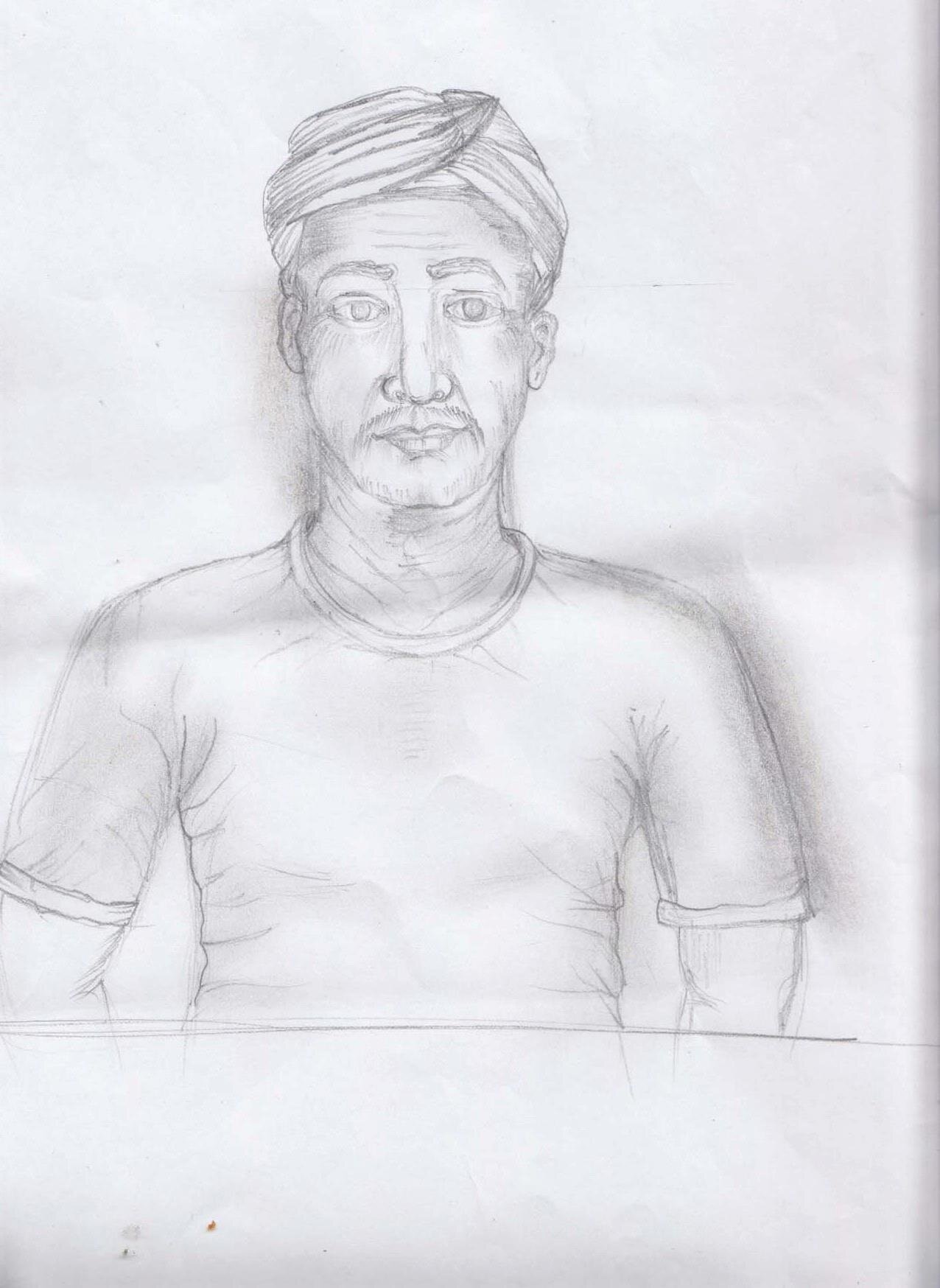
World Peace

Jagdish Prasad Mandal (Original Maithili Short Story)

Rameshwar Prasad Mandal (English Translation)
World Peace
Returning from school, Adauriya said to his mother- “Ma, tomorrow
morning I will go to Guru Uncle’s house.”
The name of Guru Uncle set Aparajita thinking, as she tried to recall
who he was.
Sensing her uncertainty, Adauriya asked- “You do not know Guru Uncle?”
Aparajita replied- “I cannot remember just now.”
Adauriya explained- “The one who lives in Uttarwari Tola.”
At the mention of Uttarwari Tola, Aparajita said- “Now I remembered.”
At that moment, she went to the courtyard trellis, cut a gourd, plucked
about two kilos of brinjal, pulled up ten or twelve radishes, removed
their roots and leaves, washed them clean, and placed them in a bag.
Early the next morning, after completing his daily chores, Adauriya came
to his mother and said- “Ma, I am going to Guru Uncle’s house. I have a
question to ask him. If I return late, I will not go to school; if I am
back in time, I will attend school as well.”
His mother simply acknowledged his words without adding anything more.
When Adauriya was about to leave for Guru Uncle’s house, she said- “Son,
there is a gourd, and in the bag there are radish and brinjal. Take them
with you and give them to Guru Uncle.”
He hesitated for a moment, slightly puzzled, but his mother repeated
gently- “When you go to someone older than yourself to seek guidance or
advice, you should take a gift as an offering.”
Until that moment, Adauriya had never truly understood such a gesture,
but that morning it became clear. His father Sukhdev’s words came back
to him: “Son, in our time, and even before, when teachers did not
receive a salary, the children—the students—would bring them a
shanichara, a pice and a quarter kilo of rice.”
Once, Adauriya had asked- “Why give them money and rice?”
Sukhdev had replied- “If you receive knowledge from someone, you must
give something in return. When knowledge is taken without any offering,
its worth begins to fade.”
Back then he had heard his father’s words without understanding them.
But now, seeing his mother’s actions, his father’s meaning returned to
him with sudden clarity. Holding the gourd in one hand and slinging the
bag with brinjal and radish over his shoulder, Adauriya set out for Guru
Uncle’s house.
As soon as Adauriya reached Guru Uncle’s doorway and saw him, he said-
“I bow to you, Uncle. I have come to know the answer of a question.”
While lowering his gaze Guru chacha blessed Adauriya, but he noticed the
bag slung over Adauriya’s shoulder and the gourd in his hand. His eyes
lifted in surprise. It reminded him of an old tradition long observed
here: whenever one received knowledge from someone, one would offer a
token of respect in return. Even Dronacharya had taken Eklavya’s thumb.
Yet, another thought stirred in his mind—that if, in exchange for giving
something, one always received something in return, if one taught only
to be paid, then it became a transaction. The gift of knowledge is the
highest of all gifts, and its sanctity remains only when it is given
freely, without taking anything in return. Otherwise, it turns into an
act of buying and selling.
Guru Uncle was still lost in his thoughts when Adauriya entered the
courtyard and placed the bag of radishes and brinjal, along with the
gourd, on the eastern verandah, saying to Guru Uncle’s wife- “Aunty,
here is a gourd, and in the bag there are brinjal and radishes. Please
keep them.”
Hearing this, Sarojini guessed at once that her husband must have sent
the boy, so she took them silently without comment.
Returning to the doorway, Adauriya touched Guru Uncle’s feet in
reverence. Guru Uncle reconised him by his face that the boy was from
Southern colony, but he did not know exactly who he was, whose son he
might be, or what his name was. Without knowing, he blessed him much as
Ramananda Swami had once said to Kabir- “Child, recite Ram-Ram,” saying-
“Be well, child. May you be blessed.”
Inviting Adauriya to sit before him with a gesture, Guru Uncle watched
as the boy sat down and said- “Uncle, I have come to ask you the answer
to a question.”
Hearing this, Guru Uncle thought to himself that he did not know the boy
well, nor his true nature. In such a case, how could he decide what kind
of answer would be right for him? The world is what it is, full of both
good and bad. If he were to call bad what is good or good what is bad,
that too would not be right.
Caught in this uncertainty, Guru Uncle decided it would be better to
know the boy before answering his question. So he asked- “Child, what is
your name?”
With the tone of a small child answering proudly, Adauriya said- “Uncle,
in school my name is Adaurilal. My friends call me Adauri, and my
parents call me Adauriya.”
Guru Uncle asked- “Your father’s name?”
Adauriya replied- “Sukhdev.”
The moment Guru Uncle heard the name Sukhdev, he recognised him. Sukhdev
from Southern colony was Adauriya’s father. Guru Uncle had once given
Sukhdev a cow to tend. As long as the cow remained in milk, Sukhdev kept
coming to Guru chacha’s place. When the cow grew old and died, that
arrangement came to an end.
Guru Uncle asked- “What is your question, Adauri?”
Adaurilal said- “Uncle, the day after tomorrow there will be a programme
at our school. The Education Minister will also be coming. All the
teachers and students of our school will be present. There will be a
seminar on the topic of ‘World Peace’. The teachers will take part, and
some students have also been given five minutes each to speak. I am one
of them, and I have come to you for guidance.”
Hearing the boy’s question, Guru Uncle thought to himself that the
greatest scholars of the world have pondered over this subject, and here
was a child wishing to speak on it. Yet he reminded himself that even if
the universe and the divine are infinite, it does not mean a young mind
cannot grasp them in its own measure. In school, in the village, and in
the home, children constantly listen to and absorb what their elders and
teachers say.
Guru Uncle asked- “Son, which class are you in?”
Adaurilal replied- “I am in the ninth.”
On hearing “ninth class,” Guru Uncle considered what the boy’s level
might be. At least he would have heard the seeds of greater thoughts.
Hearing is one thing, understanding another. Even if Adaurilal might not
yet fully comprehend the subject, he had at least heard of it. Everyone
knows that knowledge is of two kinds. One is verbal, and the other is
practical. Verbal knowledge comes first, and when it is put into action,
it becomes practical knowledge, which is the truest form of learning.
Guru Uncle said- “Son, do you understand the two words ‘world’ and
‘peace’?”
Adaurilal was a straightforward boy. A child’s mind is simple by nature,
and he was the son of such parents and such a family where deceit and
intrigue had no place. His dealings and thoughts were open and honest
with everyone. Deceit and manipulation creep into families where
stomachs are always full and business runs on a grand scale.
Adauriya said- “Guru Uncle, Master Sahib told us that everyone will have
to speak for five minutes on the topic of world peace, so I have come to
you to understand what I should say about it.”
Hearing the boy’s thought, Guru Uncle reflected that what Adauriya said
was indeed correct. As he had heard from his teachers, so he understood,
and so he spoke. He could not be expected to grasp that where each
individual’s life is filled with unrest, bringing peace into the minds
of all the world’s people is not child’s play. If the hope with which
Adaurilal had come were not fulfilled, the boy might leave in
disappointment.
Guru Uncle asked- “Adaurilal, who all will be present at the programme?”
Adaurilal replied- “Uncle, the chief guest will be the Honourable
Education Minister. All the teachers of the school will be there—eleven
in all—along with students from all four classes.”
Hearing this, Guru Uncle thought to himself that five minutes was hardly
enough time. It was barely the time taken to sip a cup of tea.
Guru Uncle said- “Adaurilal, any speech begins with a salutation. Then
comes the main subject, the matter you have to discuss, and finally you
conclude your speech. So first tell me how you will give the
salutation.”
Adaurilal said- “Guru Uncle, Master Sahib wrote it on the board and had
us all copy it.”
Guru Uncle asked- “What did he write?”
Adaurilal took out the piece of paper from his pocket and began to read:
“Respected Honourable Education Minister, Government of Bihar. Respected
Principal Sir, respected Ravindra Babu, Khushilal Babu, Kedar Babu,
Vimal Babu, Rudrachandra Babu, Singheshwar Babu, and Shubhkant Babu.
Along with the present students and…”
Hearing this list of salutations, Guru Uncle realised at once that
nearly four of Adaurilal’s allotted five minutes would be spent just on
greetings.
Adding his own suggestion, Guru Uncle said- “Son, add one more line at
the end: ‘In today’s world, unrest is the greatest problem of life.
Without peace in life, peace in the world cannot be achieved.’”
By the time Adaurilal had finished writing, Guru Uncle felt a quiet
relief. Yet his mind told him that on the subject of world peace, he
should also speak to Adaurilal directly. He asked again- “Adaurilal, are
you done, or do you wish to add more?”
Guru Uncle reflected that Adaurilal was still a child. If he gave him
more to write, especially things whose meaning the boy could not
understand, the audience might simply conclude that the speech had been
copied from a book or dictated by someone else. In that case, a third
suspicion might also arise. He decided it would be better to let the
written part remain as it was and explain verbally what the world is and
what peace is, thus keeping his own conscience clear.
Adaurilal had no real sense of what five minutes meant, how much could
be spoken or done in that time. He only felt vaguely that his speech was
too short. He said- “Uncle, please add a little more.”
Seeing the boy’s curiosity, Guru Uncle felt not displeasure but
satisfaction. Displeasure would have come only if the boy had been
shirking work, which he was not. The eagerness to learn was alive in
him, and that gave Guru Uncle contentment. Smiling, he said- “Son, first
listen carefully to what I say. Later, if you feel like adding something
from your own thoughts, you may add much, as you want.”
This thought arose in Guru Uncle’s mind for two reasons: first, he could
meet the measure of the boy’s curiosity without leaving him the
impression that his elder had been careless in guiding him; second, the
deeper ideas he held within himself were not yet within Adaurilal’s
reach. If the boy could not truly grasp them, then how can he prepare
more.
Adaurilal asked- “Shall I hear it, Uncle?”
Guru Uncle said- “What do you mean by the word ‘world’? What is the
world?”
Adaurilal replied- “The world means the earth and all that is in it.”
Hearing the answer, Guru Uncle smiled inwardly, knowing that the boy was
repeating exactly what he had heard from people’s lips and from his
books. He had no idea that the world is the composite of three elements:
Brahma, the soul, and Maya. Brahma is the essence of knowledge and
bliss; the soul is the essence of life; and Maya is the essence of
action and manifestation. Together they form the world.
In the same way, peace has its own nature. When knowledge transforms
into trust and grows, peace is born in the human heart. That peace, as
it deepens and matures, becomes a state of profound tranquillity.
Guru Uncle said- “Adaurilal, you do not have a watch, but there is one
hanging on the wall. Look at it, then read aloud the speech you have
written. From that you will know whether it fills five minutes or not.”
Hearing this, Adaurilal began to read. Being a child, he was not yet
skilled at reading smoothly, and that too added to the time. By the time
he finished his prepared text, the five minutes had been completely
filled.
अपन मंतव्य editorial.staff.videha@zohomail.in पर पठाउ।